
General Materials
Item set
- Title
- General Materials
- Alternative Title
- LRS General Materials
- Creator
- Labour Research Service (LRS)
Items
-
 A research report investigating the erosion of agricultural productivity and the prevalence of poverty in the rural areas of Region E. The study analyzes the shift from producer to consumer communities, where households depend on migrant remittances rather than local resources. It covers demographic shifts, income distribution, migration dynamics, and a socio-economic profile of rural households’ access to basic services.
 -
 A professional style guide for student journalists within the South African Student Press Union. It emphasizes the importance of "clean, correct English" as a tool for political communication. The guide covers consistency in grammar, punctuation, and terminology, while acknowledging the annual debates at SASPU Congress regarding the ideological and linguistic choices of the student press.
 -
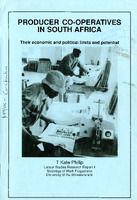 A comprehensive labour studies research report exploring producer co-operatives as a democratic alternative to capitalist enterprises in the context of mass unemployment. The dissertation analyses the roots of unemployment, the psychological effects of joblessness, and the strategies of organisations like COSATU and the NUWCC. It features in-depth case studies of the Mondragon model (Spain), the Sarmcol Workers Co-op (SAWCO), and others to evaluate the economic viability and "degenerative" tendencies of co-ops within a capitalist economy.
 -
 In recent years there has been a growing literature that advocates various forms of participatory development. This is illustrated by the promotion of approaches/tools such as participatory rural appraisal (PRA), participatory technology development (PTD), and participatory process projects 1 These "new" approaches are fast taking on the form of a new generalised orthodoxy for solving development problems. It would seem from the perspective of some of the promoters of this orthodoxy that the problem of development is no longer one of not having the right approaches and methods, but one of getting recalcitrant policy makers, bureaucrats, academics to appreciate and adopt these new methods and techniques. My concerns with this new advocacy are that: i It does not relate to experience; ii It does not address issues of power structure and control over information and other resources in multiple and complex arenas of science and technology (S&T); iii By placing major emphasis on management approaches and tools, the new orthodoxy is cutting itself off from a critical reflective understanding of the deeper determinants of technical and social change. Unfortunately, I suspect that if this new orthodoxy does not develop a more critical reflective view of itself then, like previous dominant orthodoxies, it will soon have to develop a range of "escape hatches" to explain why these participatory approaches are not giving the results that their advocates promise.,AVOCADO series; v 06/95
 -
 A compilation of stories written by learners and group leaders involved in the Montagu/Ashton Community Service (MAG) "Read and Write" project. The book resulted from a workshop held on October 5, 1985, bringing together 21 learners, 15 group leaders, and staff/friends of the MAG. It serves as a record of rural community life, labour, and the struggle for literacy in the Western Cape during the 1980s.
 -
 So much has been said and written about the Reconstruction and Development Programme by a bewildering array of development specialists, politicians, bureaucrats and commentators that it seems inconceivable that anyone familiar with policy debates would still lack an understanding of it. But amid the speeches, publications, policy documents and newspaper articles, the RDP has lost its meaning and coherence. It has come to mean anything anyone wants it to mean; with a little ingenuity, anything can be made to fit in with the goals of the RDP. It has thus become too broad and imprecise to refer only to what was originally intended. This paper offers an analysis of the RDP's approach at national and provincial levels, and provides a conceptual framework within which the RDP's Basic Needs approach to development is assessed. It forms part of a continuing project which seeks to examine the RDP and its implementation by the provinces, and was based on interviews with provincial and national RDP officials, development planners in the provinces, and a thorough content analysis of official policy documents, memoranda and minutes. The institutionalisation of the RDP will be examined by analysing problems faced in the course of implementing it in the provinces. Gauteng, Mpumalanga and North West were chosen as case studies; w'hile they were selected randomly, the goal was to examine three provinces with different socio-economic profiles, allowing significant lessons to be extrapolated from their short experience of implementing the RDP. Their priorities and strategic approaches will be assessed, and problems examined, to suggest lessons for policy and planning that might throw light on similar issues in other provinces. Finally, the paper will analyse indications that the government is making subtle strategic changes towards rearticulating the RDP within a new time frame, and moving towards a tightly co-ordinated set of institutional structures and intergovernmental planning systems.,Social policy series
 -
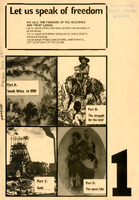 The struggle reaches back to the days of the first white settlement in our country. In this chapter we will look at some of these traditions of our struggle. We will learn more about the people who were in South Africa when the settlers came, and how they fought bravely to live in peace on their land. We will also read about the many changes that happened, particularly after diamonds and gold were discovered and how people continued to struggle against the new conditions that made their lives even harder.,“We call the farmers of the reserves and trust lands. Let us speak of the wide land, and the narrow strips on which we toil. Let us speak of brothers without land, and of children without schooling. Let us speak of taxes and of cattle, and of famine. LET US SPEAK OF FREEDOM.â€
The struggle reaches back to the days of the first white settlement in our country. In this chapter we will look at some of these traditions of our struggle. We will learn more about the people who were in South Africa when the settlers came, and how they fought bravely to live in peace on their land. We will also read about the many changes that happened, particularly after diamonds and gold were discovered and how people continued to struggle against the new conditions that made their lives even harder.,“We call the farmers of the reserves and trust lands. Let us speak of the wide land, and the narrow strips on which we toil. Let us speak of brothers without land, and of children without schooling. Let us speak of taxes and of cattle, and of famine. LET US SPEAK OF FREEDOM.†-
 While South Africa's new democracy has meant that schools are now open to all, there is still racism in our schools. The changes in schools have in some cases exacerbated racial tensions and mistrust. Teachers everywhere are struggling with the changing dynamics of their classrooms and schools. There is much talk about how to work against racism. Various programmes and schools have developed different ways of dealing with it. All have particular ideas about how best to counter it. Resisting Racism aims to discuss and understand the beliefs and assumptions underlying many of these approaches. We look at the theories behind the different practices, present a range of ideas to illustrate them and consider their limits and possibilities. The book is a starting point for teachers and schools to reflect on their practices and help them to work out new strategies in the classroom and school. The approaches described will probably work best if they are used together, specially adapted to the specific context in which they are to be used. In the first part of the book we look at psychological and sociological explanations of why people are racist. Four different ways of looking at the issues are described. Each suggests practical ways of dealing with racism in the classroom and in the school. Chapter Three, on multi-cultural and anti-racist education, covers similar ground but from a slightly different angle, looking at curriculum debates about race, culture and equality. The final section looks at the concerns that many teachers have every day, such as "How can I deal with the language problem?" and "How can I involve parents in these issues?" In discussing these questions we have tried to use current theory to inform the practical ideas suggested. You will discover that this book is not neutral. It does have a point of view. It seeks to explain the limitations of assimilating students into a status quo and asks that schools take a critical look at their policies and practices. There are no easy answers or quick solutions. However thinking about and understanding the issues of racism and the ways in which it may be resisted can only bring us closer to positive change.
 -
 The six papers which appear in this publication were delivered at a consultative conference of the National and Olympic Sports Congress which was held in Johannesburg from 1-3 November 1991. There is no doubt that this conference on development could not have been held at a more critical juncture in South Africa's history, particularly at a time when the country stands on the threshold of an era which is expected to usher in a non-racial, democratic society. Given the legacy of apartheid, development and preparation have become priorities for the National and Olympic Sports Congress. It was against the background of the inequalities and future projections for transformation of the sports network which brought delegates together from across South Africa and from all codes of sport and co-ordinating regional councils. A central theme of the papers is that the reconstruction of South African sport demands a national programme, one that would ensure progress towards an equitable sports structure but also one that would set realistic goals without raising expectations that are unlikely to be realised. A central challenge of the conference was the search for a suitable combination of high performance sport and mass participation. The gender question in sport also came under the spotlight. Sport's male-dominated, hierarchical and sexist structure was mandated for urgent review. Conference was told that black women have very few opportunities to participate in sport unlike white sportswomen and sports people overall. Five resolutions, aimed at transforming the present state of South African sport, were adopted at the conference. After exhaustive discussions delegates identified the broad themes to be: national development and planning, national sports policy, building one sports federation, sponsorship, rural areas, affirmative action and empowerment. Conference noted the absence of a co-ordinated national sports policy, the heavy commercialisation of sport together with the lack of vision and planning for the future of sport. In this regard it was resolved to intiate the acceptance and development of a national sports policy which would emphasise development, national identity and patriotism, democracy, accountability, non-racialism and non-sexism. If the conference deliberations are to be seriously implemented then the apartheid sports network will undergo structural changes which will develop the historically disadvantaged and unleash the suppressed talents of millions of people who are trapped in an unequal and resourceless system.
 -
 On October 26 1988, for the first time in the country's history, South Africans of all races will be expected to go to the polls to elect their local government representatives. Never before have these elections been held together on the same day. That is about all that is historically "new" about the coming local authority elections. Yet to the government, the forthcoming municipal elections are all-important. So much so, that it is now an offense to call on people to boycott the elections. This booklet will attempt to find some explanations for why the coming municipal elections are so important to the government. How do they fit into the National Party's political plans for the country and, most importantly, how do the majority of politically unrepresented South Africans view the elections and the structures of local government?
 -
 Detention without trial can be a formidable government weapon against political opponents. In South Africa this weapon has been fashioned into a multiple warhead. There are currently seven security law detention provisions on the statute book, of which one is dormant but can be activated by the State President. Non security law detention, for example detention under drug laws, will not be discussed in this paper. While the seven detention laws are of varying severity and serve different purposes, they are best classified and explained under two main categories or groups - preventive detention and pre-trial detention.
 -
 The professorial inaugural lecture is for the university an occasion to celebrate - celebrate in the full meaning of the word, i.e. to perform publicly and duly, to observe and honour with rites and festivities, to publish abroad, praise and extol. Through the custom of the inaugural lecture the university celebrates and affirms its basic function, that of creating, preserving, transmitting and applying knowledge, particularly scientifically-based knowledge. The university appoints to the position of professor one who has attained excellence in the handling of knowledge in her or his discipline, and through a jealous watchfulness over the dignity and esteem of this time-honoured position of excellence amongst scholars, defends the capacity of the university to advance human knowledge and human progress. The University of the Western Cape is particularly honoured to celebrate by way of this address the inauguration of its first ever Professor of Human Rights Law. We take pride from both the position and the incumbent: the post demonstrates our commitment to scholarly relevance, the incumbent to the pursuit of excellence. This university has distinguished itself amongst South African educational institutions for the way that it has grappled with questions of appropriate intellectual and educational responses to the demands of the social and political environment. That search involved debates and contests over what constitutes knowledge or valuable knowledge, over the nature of the process of knowledge production, over the relationship between theory and practice, about autonomy and accountability, about the meaning of "community" and about how the activities of a university are informed by the definition and conception of "community". The decision to establish a chair in Human Rights Law was arrived at as part of that process of searching for the appropriate forms of curricular transformation. South African society with its history of colonial conquest and latterly apartheid rule is one bereft of a rights culture; and where the discussion of a bill of rights and the general establishment of an awareness of human rights had been started in recent times, it has often been motivated by a concern with the protection of traditionally advantaged sectors of society. A university like ours has an obligation to contribute to the debate about and the promotion of human rights in ways which will also be concerned with healing, reparation and reconstruction in this severely brutalised nation. In this address marking his formal assumption of the University of the Western Cape's Chair in Human Rights Law, Kader Asmal gives testimony of the depth of scholarly rigour and the breadth of humane concern brought to and emanating from this position. The integral coming together of Asmal the international scholar, the anti-apartheid activist of long standing, the seasoned international solidarity worker, the spirited publicist is evidenced in this address which is sure to stand as a signal point of reference in our national debate about this complex subject. The University had been privileged to attract to its staff some of the finest scholars from the ranks of the formerly exiled South Africans; this inaugural ceremony provides the institution with the opportunity to welcome into its midst one of those in the person of Kader Asmal.,Publications of the University of the Western Cape ; series A, no. 64
 -
 The Environmental Justice Networking Forum's first national conference had three major objectives: to constitute the organisation on a national basis; to make policy recommendations regarding the implementation of the RDP both for submission to government and as a guide to action by EJNFparticipants; to build and disseminate the workof thelDRC/ANC/ COSATU/ SACP/ SANCO International Mission on Environmental Policy (referred to here as the Mission). EJNF was in itiated at the Earthlife Africa International Environment Conference in 1992 at Pietermaritzburg. That conference mandated an interim national steering committee to guide a process of establishing an organised voice within civil society for environmental justice. It stipulated that the organisation should be formed on a regional basis leading up to the national constitution of EJNF at a national conference. The EJNF conference is thus the culmination of a two year process. During that time, meetings were held to establish EJNF in six regions: Gauteng, Northern Transvaal, Western Cape, Eastern Cape, KwaZulu- Natal and OFS. Participating organisations include women's, rural, youth, religious and environmental organisations, unions, civics and service NGOs. Each region sent delegations to the national conference. Two other regions, Eastern Transvaal and Northern Cape, also sent delegations which will form the focus groups for establishing EJNF in those regions. Regional EJNF participant organisations also elected members to the national steering committee. They took office at the constitutive conference. The minutes of the constitutive session of the conference are not included here but are available from the EJNF national office. The EJNF delegates were joined by a number of guest delegates for the conference on Greening the RDP. They included members of national organisations which represent or work with the constitutuencies which EJNF is developing and researchers working in the sectors covered by the conference. Government was represented by Ministers Kader Asmal (Water Affairs) and Derek Hanekom (Land Affairs), by provincial MECs, by members of standing committees in parliament and provincial legislatures andby ministry or department officials.
 -
 Thousands of farmers were saved from bankruptcy by the Department of Agriculture, says Minister Greyling Wentzel. He said in 1986/1987 2 741 farmers who would have been bankrupt were saved through the department's production aid scheme. The Rill,7m they received as loans enabled them to get a crop in the ground, without which they would have gone under. The debt consolidation scheme likewise helped about 2 000 farmers escape bankruptcy for the period 1983/1984 to 1986/1987.
 -
 It is certainly true that a number of the men who have sat in homeland representative councils live in white areas. Apartheid idealogues draw two inferences from this observation. Firstly, that as the policy of separate development unfolds, urban representation in homeland councils will be a continuing trend. Secondly, that the political aspirations of urban blacks can be fulfilled in the homeland political arena. (1) Both of these conclusions can be refuted at the empirical level alone. With regard to the first, Kotze himself inadvertently provides us with evidence to the contrary. Of the seven representatives " from white urban areas" whom he mentions, four of these men were forced out of the homeland political arena, in 1975 alone. Collins Ramusi and Mageza, having become "interior ministers" for their homelands (Lebowa and Gazankulu respectively) were forced to leave their positions towards the beginning of that year, and Barney Dladla, Executive Councillor for Community Affairs in Buthelezi's KwaZulu cabinet, was ousted as well. Baldwin Mudau's Venda Independence People's party suffered continual harassment and was thwarted in its attempts to hold elections in Venda. It was decided to examine the cases of Mudau and Mageza in greater depth to explain how the demise in their roles as 'homeland politicians' occurred. This examination revealed the fallaciousness of the second and central inference mentioned earlier. It was shown that although these men lived and worked in the city, their electoral support did not come from the urban areas. Once it was established that their electoral base was in fact a predominantly rural one, the refutation of this second theme became complete. On a purely empirical level then, the contentions of Kotze et al were refuted. But to merely refute these ideological statements by providing evidence to the contrary does not answer the questions that have arisen as a result of the investigation.,Opposition politics in Venda and Gazenkulu
 -
 The Inkatha movement has received, large publicity over the few years since its revival and especially recently with the formation of an alliance between Inkatha, the ("Coloured") labour Party and the ("Indian") Reform Party, Thi3 paper was done to suggest a possible approach, for discussion, to the analysis of current political, ideological and economic developments in the reserve areas of the South African social formation. More specifically the paper hopes to provide information that could be relevant to an analysis of developments in the kwaZulu region. An elaboration of the hints at an approach, integration of factors relating to the stage of capitalism in the South African social formation and class struggle would have made this a more satisfactory paper for discussion. The approach adopted has to be extremely tentative at this stage, both because of the immediate and obvious problems associated with contemporary research and analysis (It is even less possible to approach the subject with "objectivity", to "distance oneself from it", than is the case with topics that can more properly be called "history") but also because of the dearth of material available on the reserve "homeland" areas and the difficult y of doing research in these areas. (Wages Commission research into conditions on wattle plantations, Cosmas Desmond and others and their work on resettlement etc., and subsequent responses to these investigations, give some idea of the sensitivity of thin work), In the first section I will introduce certain concepts relating to an analysis of the "homelands" through some recent writing on these areas. References will be to the kwaZulu region. The second section deal.3 specifically with the Inkatha movement. Information relating to this movement is provided and one issue is presented in greater detail, hut no rigorous attempt is mado to apply the mode of analysis of the first section to the issues around the position of 'Inkatha. Indicators exist but with so many dynamics operative they can be no more than that. However, I do not believe that it is possible to understand the political, economic and ideological developments in the "homelands" without keeping the questions raised in the first section in mind - and definitely impossible to come to an adequate understanding if these areas are looked at in isolation, ie if apparently "internal" events and processes are not situated within a context broadly defined by the specific stage of the development of capitalism in South Africa (monopoly dominance), and without keeping in mind the history of class struggle within the social formation.,Class formation in the South African reserve areas: Inkatha - a study
 -
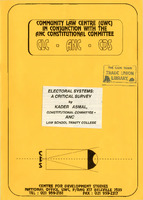 Ever since union - and before - black South Africans have been excluded from parliament, provincial councils and other law-making bodies. This means that blacks have never participated in the electoral process. The voting (electoral) system - its nature and workings - remained the sole preserve of white political parties and the Apartheid government of the day. As a result of a conjuncture of circumstances (as per Harare Declaration), the African National Congress and the apart0heid government are now engaged in talks. Hopefully this will ultimately lead to negotiations towards a new Constitution which will make provision for a single unitary, non-racial, non-sexist South Africa with universal franchise on one single common voters roll and one person one vote. Part of the process of constitution-making for such a South Africa, will be the working out of a system of voting, an electoral system, which would be appropriate for the country. The African National Congress has recognised the need for a multi-party system, the right of all other political forces and organisations to organise and to compete for power on the political terrain. The ANC also recognises that all parties enjoying significant support should have the right to be represented in a Constituent Assembly and parliament. The question which needs to be resolved is: What would be an appropriate electoral system to achieve the stated objec0tive? It is to place the issue before the people of our country and to ensure participation at the widest levels by all the organisa0tions of the people in the process of constitution-making (including formulating and/or agreeing upon an acceptable system of voting), that the African National Congress, Community Law Centre (University of the Western Cape) and the Centre for Development Studies have organised a conference to be held in the Western Cape on 2 - 4 NOVEM0BER 1990. This conference will not be a decision-making one. nor will there be any resolutions at the end of the conference. The objective is to facilitate meaningful discussions throughout the country. To facilitate this process, we present a discussion document entitled "ELECTORAL SYSTEMS: A CRITICAL SURVEY" which has been prepared by Professor KADER ASMAL, a member of the Constitutional Committee of the ANC and Professor of Law at Trinity College, Dublin. It is hoped that arising from these discussions, there will be more meaningful discussions and consultations amongst or0ganisations such as trade unions, civic organisations, women's organisations and other sectoral or0ganisations - ultimately leading to a situation which we would be better able to decide on an acceptable, unity building and democratic electoral system.,"The Community Law Centre (UWC) & Centre for Development Studies in conjunction with the ANC Constitutional Committee."--Cover
 -
-
 In October 1995 representatives from ECPAT (End Child Prostitution in Asian Tourism) visited several Eastern and Southern African countries. The purpose of the visit was to collect information on child prostitution and the impact of tourism on child prostitution and to assess whether to expand the ECPAT campaign to Africa. Although child prostitution in tourism did not presently appear to be a problem, child prostitution was found to be widespread. One common problem identified by ECPAT in all these countries visited was a lack of legislation to protect children from prostitution and a general helplessness in how best to address the issue. So the idea of a workshop, focusing on legal aspects, was bom with the aim to bring together stakeholders from the various countries to learn from each other's experiences and begin to formulate responses to child prostitution and prevent child prostitution in tourism. The Network Against Child Labour (NACL) South Africa was able to organise a workshop with the financial support from Bread for the World. Participants from NGO's and governments from Kenya, Mozambique, Zambia, Zimbabwe and South Africa attended this first workshop on child prostitution in the region. Two international legal experts and advisers to ECPAT were present and partly facilitated the workshop, enriching our work with their expertise and world wide experience. The aim of the workshop extended beyond a focus on the legal aspects of child prostitution. Other specific purposes were networking, exchanging each other's experience and achievements in order to develop strategies to combat child prostitution and finding a common ground for co-ordinated action. The Human Science Research Council (HSRC) provided a venue for the workshop and catered for the event. Dr. Willem Schurink from the HSRC organised, together with the Child Protection Unit from the South African Police, a tour to Johannesburg in areas were child prostitution is considered rife. This gave the participants an insight into the situation in South Africa's largest city and “economic capitalâ€. The two days of our workshop were intense and enriching. We all learned from each other's experience and realised that there are many common problems that could be tackled with mutual support and advice in order to change legislation, policies and attitudes in the respective countries in the Eastern and Southern African region to ensure that the problem of child prostitution is declining and eventually eradicated. Continued networking and intensifying contacts will be part of our future efforts to combat child prostitution. The NACL wants to take this occasion to thank all participants for their efforts and contributions that made the workshop a success: Muireann OBrian and Denise Ritchie, who helped us in organising and facilitating. Thanks to our two volunteers, Rakgadi Masetlha and Tilman Rapp for the organisation of the workshop and especially to Dr. Willem Schurink of the HSRC, as well as to the funder - Bread for the World. With this publication we hope not only to reach stakeholders in South Africa and the region but to contribute our experience to world wide efforts to eradicate the degrading and often lethal practice of child prostitution by encouraging organisations and individuals to join a network in order to fight the problem.
 -
 As women in South Africa, it is important for us to understand the nature of our oppression, for it is only after understanding it, can we identify the target of our attack and plan the appropriate strategy and tactics for our struggle. Black women in South Africa suffer three types of oppression. 1. Political oppression, which is common to all blacks in South Africa, ie. the denial of rights to vote for or choose the type of government we want, and the denial of rights as a people in South Africa. 2. Economic oppression as black workers in South Africa. Black women workers are even more exploited than men workers. They are paid lower wages for the same job, are treated as temporary staff and can be fired at anytime especially if they fall pregnant. 3. Social oppression which stems from the idea that women are born inferior to men and therefore have to play an inferior role in society. The socialization process starts at birth and women and men are geared towards certain roles in society. Men most often towards leadership positions and professional jobs and women towards household duties and secretarial jobs. This socialization process continues throughout ones life such that most people accept it as a natural phenomenon and a way of life. Having understood the forms of oppression, we can see that the struggle is not between men and women, where men are seen as the source of our oppression. Nor is it a struggle for mechanical equality between men and women ie. being paid the same wages as men, and having equal status as men in society, because this will mean equality within the present status quo. Our struggle is a struggle between womenand the existing social order. It is a struggle of the oppressed against oppression. Our main weapons in the struggle for liberation are UNITY and ORGANISATION. Unity is realised through common effort, links are forged through collective work and study, through criticism and self-critcism and through action against opression. Organization can be achieved through women's groups and organization. A women's group's first demand should be the clarification of our ideas, to get rid of miscosepts and erroneous ideas concerning the role and liberation of women. A women's group usually tackles the question of social oppresion, but more important, it must be seen as a stepping stone towards involvement in the broader struggle can we destroy the foundations of exploitative society and rebuild society on new foundations. Foundations built on the demands of the FREEDOM CHARTER. “The fundamental struggle is for national liberation of the oppressed people of South Africa, and any women's organization that stands outside this struggle must stand apart from the mass of women. What was realised by the Federation of South African Women was that it would be impossible for women to achieve their rights as women in a society in which so many fundamental rights are denied to both men and women by virtue of their colour and their class. Therefore just as there can be no revolution without the liberation of women, the struggle for women's emancipation cannot succeed without the victory of the revolution".
 -
 The majority of the residents of Khutsong are employed at mines in the area south of Carletonville (stretching form East Driefontein in the east to Deelkraal in the west), as well as in Carletonville itself. The large majority of these people are dependant on public transport for commuting to work, for undertaking trips for shopping purposes and for going to school. The condition of the road network in Khutsong is of such a nature that large areas are totally inaccessible to public transport (especially in the rainy season) resulting in a situation where large numbers of people have to walk unacceptable long distances between their places of residence and public transport routes. A comprehensive programme have been embarked upon in consultation with the community to rectify this situation.
 -
 The basic objectives of ANC policy are threefold: * To overcome the legacy of inequality and injustice created by colonialism and apartheid, in a swift, progressive and principled way; * To develop an economy and state infrastructure that will progressively improve the quality of life of all South Africans; and, * To encourage the flourishing of the feeling that South Africa belongs to all who live in it, to promote a common loyalty to and pride in the country and to create a universal sense of freedom and security within its borders. These are not mutually exclusive goals. On the contrary, the future of our country depends on the harmonious and simultaneous realisation of all three. The advancement of the majority of people will, in the medium-and-long-term, release hitherto untapped and suppressed talents and energies that will both boost and diversify the economy. Developing the economy will, in turn, provide the basis for overcoming the divisions of the past without creating new ones. Finally, the achievement of a genuine sense of national unity depends on all of us working together to overcome the inequalities created by apartheid. The beacons guiding these advances are equal rights, nonracialism, non-sexism, democracy and mutual respect. A broad, inclusive approach, free of arrogance or complexes of superiority or inferiority, is fundamental. We have to develop a truly South African vision of our country, one undistorted by the prejudices and sectarianism that has guided viewpoints on race and gender, in the past. We have to rely on the wisdom, life experiences, talents and know-how of all South Africans, men and women. There can be no apartheid in finding solutions to the problems created by apartheid. This document does not present a rigid ANC blue-print for the future of South Africa, to which our supporters will be expected to rally and our opponents required to submit. Rather, the document represents a set of basic guidelines to policies we intend to pursue. These ideas will be developed through discussion within the ANC, and through consultation with the broadest spectrum of South African public opinion. The policies will be adapted according to these processes and on the basis of experience. Our problems run deep It is necessary to dwell on the problems which will be faced by the first government which is elected under a new democratic constitution. It will help create an understanding of the magnitude of the tasks involved in transforming our country into one where everyone can enjoy a reasonable standard of living combined with peace and security. It will underline the fact that there are choices to be made and priorities to be established. The nationalist government has pursued active political and social policies which, amongst others things, have led to: extreme levels of poverty and disease in the rural areas; the creation of urban ghettos where people have been denied access to even the most basic means of survival as a result of severely limited access to decent homes, electricity, water-borne sewerage, tarred roads, and recreational facilities; an education system preparing the majority of South Africans for lives of subordination and low income wage jobs; a social security system geared almost entirely to fulfilling the needs of the white minority; a health system that has seriously neglected the wellbeing of most South Africans; the social and political marginalisation of the majority of people, the African community in particular, their exclusion from public life and decision [ making as well as the denial of their culture. Gender discrimination has either excluded or subordinated the nature of women's participation in all socio-economic and political institutions. Combined with apartheid, this has resulted in African women being the most exploited and poverty stricken section of the South African population. Both the political system of apartheid and the pattern of economic development in our country, have been responsible for these developments. The white minority have used their exclusive access to political and economic power to promote their own sectional interests at the expense of black people and the country's natural resources. Black people have been systematically excluded and disadvantaged economically with the result that South Africa has one of the most unequal patterns of income and wealth distribution in the world. Since the mid-1970s, the South African economy has stagnated. An average growth rate of 6% in the 1960s declined to 3% in the 1970s and is now below 1%. Unemployment is estimated at over 40% of the economically active population. For over forty years, economic strategy was based on expanding industry through the substitution of hitherto imported manufactured goods for the wealthy minority. There has also been an emphasis on strategic industries such as arms and petrochemicals. This led to the emergence of a significant manufacturing sector in our country, but one which is generally uncompetitive in terms of international costs and prices. The alienation of land from the indigenous people and the denial of the African majority's rights to land and political power in our country are intimately connected. The agricultural sector in South Africa is currently experiencing a deep crisis. Debt levels of white farmers have reached R14 billion. These problems have led to rapidly increasing unemployment and a serious decline in living standards. Our people remain divided. We do not know each other. We are prevented from developing a national vision, in terms of which, we would see our country through the eyes of all its citizens, and not just one group or another. We live apart, physically separated, spiritually alienated, frightened of getting too close, knowing that we have different life-chances and different views of what change means. We are ruled by a multiplicity of fragmented departments, boards, councils and ministries. Apartheid has left us apart. Policies for transformation In this context it is vital that the ANC develops a clear response. This response must be aimed both at establishing a new and democratic political dispensation that replaces the racist and undemocratic apartheid constitution and addresses the legacy of apartheid in the broader socio-economic sphere. This document is a direct response to the above challenges. It sets out for discussion a comprehensive set of guidelines highlighting the ANC's broad policy response to all the major areas of political, social and economic life. The document is structured so as to highlight the strong relationship between the creation of political democracy and social and economic transformation. It is critical, however, that we honestly face up to the extent of the problems confronting our country. They are not going to be solved overnight and there are no easy or quick solutions. The problems run deep and resources are limited. Accordingly, the policies proposed here represent our broad vision. These policies highlight, our ultimate goals, which will need to be transformed into effective and realisable programmes in the short-term. In other words, we will need to establish priorities both within each of the different policy areas and between these broad areas. These priorities must be arrived at through democratic discussions and decision making processes and we must establish just and efficient mechanisms for implementing these decisions. Progress will also depend on involving as many sections of our society as possible in finding solutions.
 -
 Nationalisation involves putting any section of the economy under the control and ownership of a government. Nationalisation is not new to South Africa. The governments of the past and especially the Nationalist Party have nationalised a number of industries in the South African economy. Today almost 54% of the productive assets in the country are in the hands of the government. Transport, electricity, post office, are a few examples. Nationalisation in the past has been used to benefit only the whites, by providing them with jobs and services.
 -
 An analytical introduction to the CORD welfare programme. It critiques the existing South African welfare system's urban and racial biases and proposes a holistic, developmental model. It focuses on training auxiliary workers to address the shortage of rural professionals and suggests that welfare can serve as a catalyst for broader community growth.