
General Materials
Item set
- Title
- General Materials
- Alternative Title
- LRS General Materials
- Creator
- Labour Research Service (LRS)
Items
-
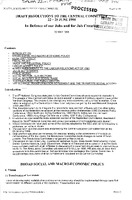 A comprehensive draft resolution delegated by the 6th National Congress to the Central Committee. It serves as a unified policy framework, integrating resolutions from COSATU affiliates and findings from the "September Commission" (The Commission on the Future of the Unions). The document synthesizes a decade of policy conferences (1992–1997) to form the labor movement's formal proposal for the Presidential Jobs Summit. It covers economic policy, health and safety, and living wage mandates, wielding the same authority as a National Congress resolution.
 -
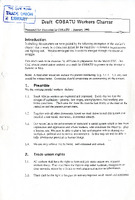 A draft policy document intended as a "dynamic organisational and fighting tool" for the democratic transition. It outlines the core demands of the labour movement regarding constitutional rights, including the right to strike, organisational independence, and gender equality. This version was circulated for affiliate discussion ahead of the March 1992 Central Executive Committee (CEC) and the subsequent Workers' Summit in May 1992.
 -
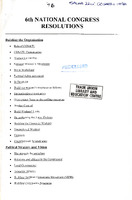 A formal resolution from the 1997 National Congress outlining the mandate for COSATU to intervene in affiliate unions facing internal problems or external disputes. It instructs the Central Executive Committee (CEC) to develop guidelines for such interventions based on constitutional clauses 3.9 and 3.10. The resolution emphasizes that while COSATU must provide visible leadership and coordination during major disputes with employers, these actions must not undermine the institutional integrity of the affiliate unions.
 -
 A progress report detailing the revitalisation of the FAWU Research/Resource Unit, which resumed operations in 1997 after a two-year closure (1995–1997). The report acknowledges a lack of internal research capacity to support bargaining structures and describes the contractual arrangement with the Labour Research Service (LRS) to provide senior-level supervision. It candidly discusses the "hiccups"—including financial constraints, limited staffing, and capacity gaps—that have hindered the unit’s goal of achieving full organizational independence.
 -
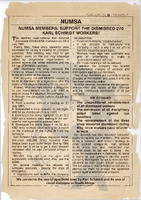 A call for solidarity following the dismissal of 270 NUMSA members by German multi-national Karl Schmidt on July 22, 1987. The conflict began with the dismissal of three shop stewards for organising a meeting regarding the May 5-6 stayaway (protesting "white" elections and the SARHWU killings). Management's refusal to arbitrate or allow a legal strike ballot led to mass dismissals of both night and day shifts while workers waited for management engagement.
 -
 A collection of discussion documents and opening remarks from the 1996 FAWU conference on Education, Training, and Development (ETD). The text highlights the union's shift toward viewing ETD as a tool for economic liberation, moving workers away from low-skilled, low-security labour toward career progression. It specifically addresses the alignment between worker development and industrial productivity through tripartite consultation between labor, the state, and employers.
 -
 This document is the constitution of the National Union of Public Service and Allied Workers (NUPSAW), adopted in 1998. It sets out the union’s foundational principles, objectives, organisational structures, membership provisions, and governance procedures. The constitution provides insight into the formation and early institutional framework of a public sector trade union in South Africa during the late apartheid period.
 -
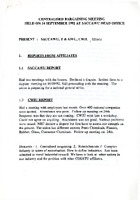 Minutes of a centralised bargaining meeting held at the SACCAWU Head Office on 14 September 1992. The document records reports from COSATU-affiliated unions on engagements with employers, disputes, and strategies relating to centralised bargaining across multiple sectors, including transport, chemicals, printing, contract cleaning, security, and higher education. It outlines union demands, challenges in sectoral and industry-level bargaining, proposed industrial councils, and strategic actions leading up to subsequent meetings.
 -
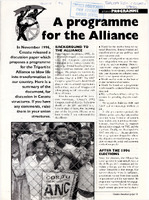 A summary of COSATU's 1996 proposals to revitalise the Tripartite Alliance. It critiques the shift toward neoliberal economic policies (GEAR), discusses the "dual power" situation in post-apartheid SA, and proposes a binding Reconstruction Accord to prioritise the RDP.
 -
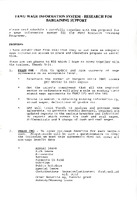 This document outlines a technical strategy from the late 1990s to professionalise the collective bargaining capacity of the Food and Allied Workers' Union (FAWU). It describes a partnership with the Labour Research Service (LRS) to develop a digitised Wage Information System (WIS), enabling the union to transition from anecdotal evidence to data-driven negotiation. This proposal, likely authored by an LRS senior researcher (Reza Daniels), details a two-phase implementation plan for a Wage Information System (WIS) at the FAWU Head Office. Phase One (Wage Data): Focuses on the logistical challenge of centralising signed wage agreements from regional coordinators. It establishes a workflow for analysing "cash vs. real wages," wage differentials, and percentage changes across sectors. Phase Two (Non-Wage Benefits): Addresses the "hidden" part of the social wage. Since formal agreements often omit specifics, the plan involves surveying shop stewards via questionnaires to capture data on sick leave, allowances, medical aid, housing loans, and retrenchment packages.
 -
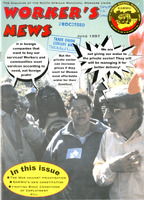 The inaugural issue of the SAMWU Magazine serves as a foundational document for the South African Municipal Workers' Union, following its formation in 1987. Published during a critical period of transition in South African labour history, the issue outlines the union’s militant stance against the privatisation of local government services and highlights its leadership in the National Living Wage Campaign. The content reflects a dual focus on internal organisational building—featuring the new union constitution and the role of service committees—and broader socio-economic advocacy, including critiques of the Employment Standards Bill and the Labour Relations Act (LRA). Notably, the issue integrates technical workplace safety concerns, such as the environmental hazards of municipal sludge, with political education and international worker solidarity. By documenting the early policies of the union and its affiliation with COSATU, this issue captures the emergence of a unified, worker-controlled movement dedicated to transforming municipal service delivery in a post-apartheid South Africa.
 -
 A strategic report outlining FAWU's critique of economic liberalization. It highlights the "dilemma" where lower food prices for consumers come at the cost of local job losses due to the inability of domestic producers to compete with imports. The report calls for a systematic balance between consumer and producer interests, centered on "household food security." It directly critiques the GEAR (Growth, Employment and Redistribution) strategy for failing to meet its targets and perpetuating poverty, while advocating for the establishment of an implementation forum based on the "Poverty and Inequality" report.
 -
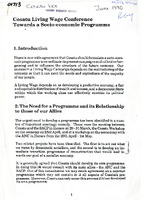 A strategic discussion paper proposing a comprehensive socio-economic framework for COSATU during the transition to democracy. It advocates for a "Growth Path" that moves beyond "bread and butter" issues to address industrial restructuring, human resource development, and the role of the State in a post-apartheid economy. It outlines the establishment of five specific commissions (Macroeconomics, Industrial Restructuring, Human Resources, LRA/Workers Charter, and Social Services) to synthesise labour policy with the ANC and SACP.
 -
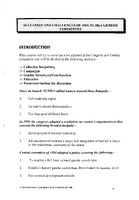 A comprehensive report prepared for the NUMSA National Gender Conference in 1998. It evaluates the union's progress on gender equality since 1993, specifically regarding maternity rights, childcare, and women's leadership. The document identifies major obstacles, including the rejection of a quota system, lack of gender sensitivity among male negotiators, and the absence of disaggregated data on female membership. It proposes a "Gender Analysis" framework and recommends integrating gender into shopsteward training and collective bargaining structures.
 -
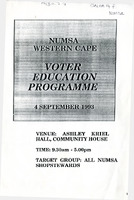 A resolution from the September 1993 Western Cape congress detailing NUMSA's political strategy for the 1994 general elections. Key points include: 1) Formal support for the ANC in the elections; 2) Affirmation of COSATU’s independence from political parties and the post-apartheid state; 3) A demand for restructuring the Tripartite Alliance to ensure a "bottom-up" mandating process and regular report-backs; 4) A commitment to intensify voter education and leadership development to ensure workers' interests influence political negotiations through COSATU.
 -
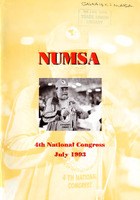 Records of the Fourth National Congress of the National Union of Metalworkers of South Africa (NUMSA), held in Johannesburg from July 1–4, 1993. The congress was attended by 773 delegates representing all 11 NUMSA regions. This congress was a turning point for the union’s political policy, featuring the election of new national office bearers and critical debates regarding the Tripartite Alliance, the "Worker’s Charter," and the union's stance on the upcoming 1994 general elections.
 -
 A research-driven report presented at the SACCAWU National Organising and Bargaining Conference (March 19-21, 1993). The document analyzes significant wage disparities across the retail and hotel sectors. It identifies the absence of a unified wage policy as a primary obstacle to effective bargaining and utilises data from the Labour Research Service’s "AWARD" (Actual Wage Rates Database) to benchmark existing rates and propose a standardised wage guideline.
 -
 A detailed financial assessment was presented to the T&GWU Congress. The report notes a significant stabilisation of union finances, primarily due to the 1988 Congress decision to increase membership subscriptions from R3 to R4. Despite improved internal income, the report issues a "note of caution" regarding rising expenditure and a continued "heavy reliance" on overseas funders for legal fees and education programs. It warns that without disciplined spending, the union faces a return to a "constant threat of bank overdraft" and remains far from achieving total self-sufficiency.
 -
 A strategic progress report presented at the T&GWU Bi-annual Congress in Johannesburg, May 1991. The document situates the union within the "period of the 90s," characterised by the challenge of transferring power to the people. It defines T&GWU as a key component of the liberation forces and the National Democratic Revolution (NDR). The report emphasises the necessity for the working class to shape the political content of the transition by advancing a specific class perspective through struggle. It calls for an honest organisational self-assessment of the sixteen months following the unbanning of political organisations.
 -
 The past year has been a very dramatic one for TGWU. It has been a year of enormous growth in membership, and at the same time a year where we have had to deal with the traumas of numerous mergers (both into TGWU, and TGWU membership into other unions). We have had to endure the difficulties of being without a physical locality for our head office for three months (after the bomb attack on Cosatu House), and more recently the arson attack on our head office premises. In an attempt to cope with the growth of the union we have developed new structures, and have expanded our staff at all levels. The year has also of course been a very dramatic one for the trade union movement as a whole, and for Cosatu in particular. The two most serious features of this have been the restricting of Cosatu in terms of the State of Emergency (along with 17 other organisations), and the proposed Labour Relations Amendment Bill. TGWU has tried to address these issues with the seriousness and determined opposition that they deserve. As a result, the state has seen fit to clash with our members, as witnessed by the detention (and now trial) of our first vice president, Comrade Alfred Ndlovu, and at least 15 other TGWU memebers over the past year. Nine TGWU members are still suffering in the isolation and evilness of detention.
 -
 A foundational educational manual and primary source reader compiled for the Workers’ College. It documents the launch and structural framework of the National Economic Development and Labour Council (NEDLAC) in February 1995. The reader includes the "Founding Declaration," the NEDLAC Act and Constitution, and the landmark launch speeches by Tito Mboweni (Government), John Gomomo (Labour/COSATU), and David Brink (Business). It outlines the "quadripartite" structure (Labour, Business, Government, and Community) and the four specific chambers: Public Finance, Labour Market, Trade and Industry, and Development.
 -
-
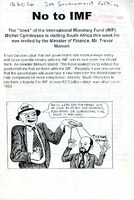 A protest pamphlet and mobilisation call issued by CANSA following the visit of IMF Managing Director Michel Camdessus to South Africa in October 1996. The document critiques the South African government's shift toward "Structural Adjustment Programmes" (SAPs) and the adoption of the GEAR (Growth, Employment and Redistribution) strategy. It outlines the "Dangers of the IMF," including privatisation, cuts to social spending, and trade liberalisation. It concludes with the announcement of CANSA’s launch in Gauteng and Cape Town on 15 October 1996, as an alliance of NGOs, trade unions, and community groups.
 -
-
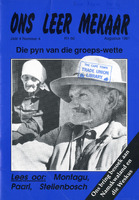 A community education magazine documenting grassroots struggles and social initiatives in the Western Cape. Key features include an investigation into the Montagu Woodworkers Co-operative (a worker-owned business), a travel report on land struggles in Namakwaland and Elandskloof, and a profile on "Ma Karriem," a Worcester activist and poet. The issue also addresses the housing crisis in Stellenbosch (SHAC) and includes practical "Hulp-hoekie" advice on homemade soap to counter the high cost of living.