
General Materials
Item set
- Title
- General Materials
- Alternative Title
- LRS General Materials
- Creator
- Labour Research Service (LRS)
Items
-
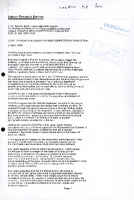 A 1998 press statement outlining COSATU’s support for "strict anti-trust legislation." The document rejects business opposition to ministerial discretion in merger regulation and advocates for the forced divestiture (breaking up) of conglomerates that abuse their dominant market position. Key focus areas include the erosion of inherited corporate power, the prevention of excessive pricing, and the inclusion of "public interest" criteria—specifically the protection of jobs—in merger reviews.
 -
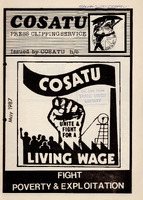 The Congress of SA living wage campaign will be launched towards the end of this month. Already various regions report that police are refusing permission for public launches to be held. Initial plans by some regions to launch the campaign at the end of this week, to coincide with the commemoration of the Sharpeville and Langa massacres, had to be shelved when permission to hold a mass rally was turned down. Cosatu has vowed to make this the "biggest challenge to bosses and their profit system". The struggle is also seen as more than just an economic one. "It is a struggle against apartheid- capitalism which is built on ultra-cheap, ultra- controllable and super-exploitable labour.
 -
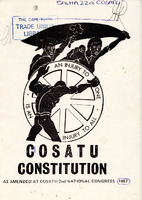 We the Trade Union representatives here present firmiy commit ourselves to a unified democratic South Africa, free of oppression and economic exploitation. We believe that this can only be achieved under the leadership of a united working class. Our history has taught us that to achieve this goal we will have to carry out the following tasks. To organise the unorganised workers and build effective trade unions based on the democratic organisation of workers in the factories, mines, shops, farms and other workplaces. Organise national industrial trade unions, financed and controlled by their worker members through democratically elected committees. Unify these industrial unions into a national worker controlled federation. Combat the divisions amongst the workers of South Africa and unite them into a strong and confident working class. Encourage democratic worker organisation and leadership in all spheres of our society together with other progressive sectors of the community. Reinforce and encourage progressive international worker contact and solidarity so as to assist one another in our struggles.We call on all those who identify with this commitment to join us and the workers whom we represent as comrades in the struggle ahead. We call on all trade unions to strive to unite their members in their ranks without discrimination and prejudice, and therefore resolve that this federation shall determinedly seek to further and protect the interests of all workers and that its guiding motto shall be the universal slogan of working class solidarity: "AN INJURY TO ONE IS AN INJURY TO ALL".
 -
 This issue critiques the Bantustan policy as a "dead end," analyzes South Africa's "Outward Policy" of economic expansion into Africa, and features reflections on "Black Disinvolvement" by Nadine Gordimer and the "Slave Mentality" by Selby Msimang.
 -
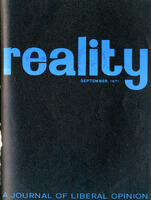 This issue critiques the "blind side" of Nationalist cynicism, analyzes the rise of SASO and the Black Consciousness Movement, and provides a "close look" at the devastating inequalities in Bantu Education. It includes a tribute to the late Mary Lee.
 -
 This issue examines the "Dialogue" movement between South Africa and Black African states (specifically Houphouët-Boigny), the 1971 Republic Day boycott, the "Polarisation" vs. "Dialogue" debate in student politics, and a critique of the Dutch Reformed Church.
 -
 This issue analyzes the state's "campaign" against English-speaking clergy and the systematic expulsion of foreign ministers. It includes Sonny Leon’s vision for the Labour Party, Edgar Brookes’ analysis of the first three Spro-cas reports, and a satirical future-history of public executions in South Africa.
 -
 This issue critiques the 10th anniversary of the Republic, highlighting the "Coloured" Labour Party's defiance of the government-created Representative Council. It includes Neville Curtis's call for a boycott of Republic Day celebrations, supported by an array of socioeconomic statistics, and an analysis of Afrikaner linguistic conservation.
 -
 This issue features a keynote address by British Labour politician Denis Healey on the "Opinions of Mankind" regarding Apartheid. The editorial expands on Terence Beard's thesis that the "Common Society" is impossible without closing the catastrophic economic gap between races. It also explores the "otherness" created by poverty and the psychological barriers to change in the white electorate.
 -
 This issue focuses on the judicial crisis following the re-detention of the "22" (including Winnie Mandela), the role of student protests in challenging arbitrary state power, and the ethical dilemmas of the English-speaking community. It includes Edgar Brookes on the "State of the Republic" and Peter Randall on the "Social Dynamics of Change."
 -
 This issue focuses on the shifting spectrum of student activism in the 1970s, the role of the Church in politics, and the government's introduction of the "Book of Life" (Identity Document). It features Neville Curtis on the emergence of Black Consciousness (SASO) and its challenge to NUSAS, as well as an analysis of the deportation of the Rev. Dick Cadigan.
 -
 Published following the 1970 General Election, this issue critiques the "annihilation" of the Herstigte Nasionale Party and the "sham" of separate development. It features Edgar Brookes on the "Brain Drain" of liberal academics and Donald Gillham’s philosophical inquiry into the nature of revolutionaries versus bigoted conservatives. Other topics include the threat to African writing and the dilemma of liberals regarding the Middle East conflict.
 -
 A 1970 issue exploring the inherent link between politics and sport, the legacy of Jan Smuts, and the struggles of writers in Zulu and Afrikaans. Key articles include André Brink's analysis of the Afrikaans writer's moral dilemma and Edgar Brookes' reassessment of Smuts. It documents the police harassment of the non-racial South African Soccer Federation and the banning of athletes Arthur Ashe and Papwa Sewgolum.
 -
 A 1970 issue exploring the "General Election for What?", Nadine Gordimer’s critique of censorship as a "homeland" for the mind, and E.G. Malherbe’s analysis of the newly legislated "autonomous" non-white universities. It features a critical look at the "Poverty Gap" and the psychological struggle within the Afrikaner personality between rigid authoritarianism and modern "man-of-the-world" Calvinism.
 -
 A 1969 issue dedicated to the centenary of Mahatma Gandhi and his relevance to a "violent world." The editorial analyses the unexpected victory of the anti-apartheid Labour Party in the Coloured Persons' Representative Council elections, mocking the government's attempts to nominate losing candidates to maintain control. It also includes Edgar Brookes' analysis of the "sullen silence" of oppressed South Africans and Donald Molteno’s critique of the "B.O.S.S. Act" (Bureau of State Security).
 -
 A 1969 issue featuring an editorial on the Apollo 11 moon landing ("In Peace for All Mankind") and its implications for global unity. It includes a tribute to the rebanned Liberal Party leader Peter Brown by Alan Paton, an analysis of Emily Hobhouse’s pacifism and passive resistance by Marie Dyer, and a philosophical exploration of the "tensions" within liberalism by C.O. Gardner. The issue also reviews the film "Katrina" and discusses the American campus protest scene.
 -
 A 1972 issue featuring a sharp critique of the English-language press for supporting the government's external "dialogue" policy and using state-sanctioned terminology like "terrorist" for guerrilla fighters. It includes a significant field report by David de Beer on the political shift in South West Africa (now Namibia) following the 1971 World Court Opinion, detailing the student boycott in Ovamboland and the opposition of the Lutheran churches to apartheid. Other articles cover the Coloured Persons' Representative Council, literacy work in Swaziland, and South Africa's expansionist foreign policy
 -
 A 1969 issue of the liberal journal featuring an editorial on the global student rebellion, comparing South African student protests to those in Spain, Czechoslovakia, and Poland. It includes a foundational article by Anthony Barker on the "vivid humanity" and systemic disadvantages of African nurses, and a comparative study by Alan McConnell Mabin on the press in Communist Yugoslavia versus the "sensationalist" South African press. The issue explicitly challenges "eiesoortige" (own-kind) development as a tool for rigid racial separation.
 -
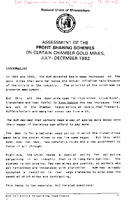 In 1991 and 1992, the NUM accepted basic wage increases on the gold mines that were far below the annual inflation rate because of the crisis in the industry. The priority of the union was to preserve employment. But this left the door wide open for rich mines (like Kloof, Elandsrand and Vaal Reefs) to hide behind the low increases that are set in the Chamber negotiations at levels that Free gold, BuffeIsfontein and marginal mines can live with. The NUM decided that workers need a way of adding more money onto their wages If the mines can afford to pay more. The ideal is for a national wage policy in which the richer mines can help the poorer mines to pay the same wages. But this will mean new tax laws, new ownership rules and a new government to force it all through. Right now, the union needs a special policy for collective bargaining in an industry that is in long term decline. The economy is not growing, few new mines are opening, so workers who get retrenched are threatened with starvation. NUM has already accepted a reduction in real wage standards to slow down the speed at which mines are contracting.
 -
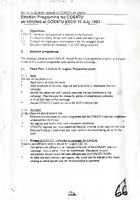 This policy document outlines the strategic mandate of the Congress of South African Trade Unions (COSATU) in the lead-up to the 1994 democratic elections. Adopted by the Executive Committee (EXCO), the programme formalises the federation’s "Three Priorities": Political Mobilisation: Ensuring a decisive electoral victory for the African National Congress (ANC) and securing its legitimacy to govern. Organisational Development: Strengthening the internal structures of COSATU to transition from a resistance movement to a sustainable force in a post-apartheid economy. Advocacy for Worker Interests: Establishing a framework to ensure the ANC-led government prioritises labour rights, specifically through the implementation of the Reconstruction and Development Programme (RDP).
 -
 A report or institutional summary of the Food and Allied Workers' Union (FAWU) Research Unit's operations from 1998 to 2000. It details the unit's establishment at the Head Office as a joint venture with the Labour Research Service (LRS), funded by FNV-Holland. Key personnel mentioned include Thandi Yoli, Viva Mtai, and Reza Daniels. The unit's primary objective was to increase FAWU’s bargaining capacity through the production of sectoral reports.
 -
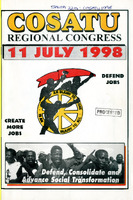 Records of the COSATU Western Cape Regional Congress held on 11 July 1998. The congress focused on mobilizing workers in the Western Cape province under the national theme of "Defend, Consolidate and Advance Social Transformation." Key agenda items included regional strategies for the 1999 General Elections, local government delivery, and addressing job losses in the regional textile and agricultural sectors.
 -
 A report detailing the implementation of the "Women Empowerment" congress resolutions during the 1998 calendar year. The document outlines the execution of the union's national year plan, specifically focusing on: 1) Mechanisms to empower women within the union structure; 2) The development of education and training programs tailored to women's needs; 3) Strategies to engage male members in gender activities to broaden the understanding of gender issues. Implementation methods highlighted include national gender schools and specialised workshops.
 -
 A policy resolution from the COSATU Education Conference focusing on the strategic priority of women's leadership development. Key mandates include: 1) The implementation of a quota system for training course participants; 2) A clear definition of "women development" that targets shop-floor workers to build leadership at all organisational levels; and 3) An inclusive approach designed to reach a broad base of women rather than a select few.
 -
 A comprehensive training manual and workshop guide designed by the COSATU Education Department in September 1999. The pack provides a "baseline" introduction to the Employment Equity Act (EEA), focusing on its application to address discriminatory workplace practices. It uses an activity-based methodology to help shop stewards understand the Act's implications for collective bargaining. The document emphasizes reporting legal loopholes back to the Federation to strengthen future labor campaigns and challenges the employer's demand for "flexibility" by asserting the legacy of apartheid imbalances.