
General Materials
Item set
- Title
- General Materials
- Alternative Title
- LRS General Materials
- Creator
- Labour Research Service (LRS)
Items
-
 Lebogang Tsotetsi is 18 years old. In October last year she wrote us this letter: 'I am a very lonely 18-year-old girl. I am HIV positive.' In response 287 Upbeat readers wrote to her, offering support and friendship. We at Upbeat were impressed and touched by Lebogang's courage and by the warmth and kindness of so many of our readers. Now Lebogang has written an open letter to all Upbeat readers. Read about her experiences and hopes for the future on page 28. What else is there in Upbeat? There is lots to learn about. When lightning flashes across the sky, is it safe to hide in a taxi? Find the answer in our science story. What was it really like to live and work on a Gold mine 100 years ago? Why did some people get rich while others suffered great hardship. Don't miss our history story on page 8. Teachers don't forget our special Teacher's Guide, with each issue of the magazine. Our easy-to-follow lesson plans will bring fresh ideas to your classroom. Enjoy reading and learning with Upbeat!
 -
 School is out! Christmas is around the corner. So put up your feet and enjoy your well-earned holiday break. And don't be without Upbeat. This issue is packed with great holiday reading; quizzes, holiday places to visit, cassettes and books to win. Boys move over! There is a new soccer wizard, to make you tremble in your boots - HER name is Fikile Sithole. Meet her on page 8. There's also lots of great music in this issue. There's a poster of all your local favourites on page 20. But also learn about the golden oldies, who had your grandparents up and jiving. We hope you like our FREE Peace Begins with you' poster. Read it, talk about it and put it up on your wall. We hope the ideas help to bring a little peace, into your neighbourhood and home. Hundreds of readers wrote to us this year. Many letters were about violence; in the street, at home and in school. The terrible violence this year brought pain and suffering to many people. For too long apartheid has destroyed people's hopes and dreams. We want peace and democracy in our land. We want proper schools, were all young people can enjoy learning. Thank you for supporting Upbeat this year and for filling our pages with your wonderful poems, letters, stories and ideas. We wish all our readers a happy and peaceful holiday.
 -
 It's the end of a big year for all South Africans. April saw all of us rejoice and celebrate as Nelson Mandela became the first president of a free South Africa. But it has also been a difficult year. 'What's the use of freedom if our daily lives are ruled by guns?' This issue is explored in our feature 'Guns - what's to be done?' on page 4. But the youth of our country continue to believe in the future. Read about how young people in Wattville, are using their talents to brighten up their own neighbourhood on page 30. Now it's holiday time and Upbeat is packed with fun reading, games and lots of information on great holiday reads. So put up your feet and enjoy your well earned break. We wish all of you a happy and peaceful holiday. Thank- you for your support in 1994.
 -
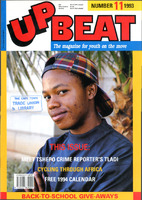 Christmas is around the corner and it's holiday time again. So grab your Upbeat, put up your feet and enjoy your well- earned rest. This issue is packed with great holiday reading. Meet Mignon - the muscle maker, discover Africa's music queens or find out about a great new book to read. In our comic, The Galaxy Arcade Kids, Nomonde finds herself in trouble. Don't miss it. In this issue you will also find your FREE 1994 calendar. It is bright and colourful and its message is for peace and democracy in 1994. Upbeat believes that learning should always be fun. Find out about a great new Upbeat product on page 17. Once you see it, Africa will never be the same again! We wish all our readers a happy and peaceful holiday. During the last week of September, Upbeat together with the Weekly Mail Book Week and Film Festival, ran workshops. We went to Daveyton, Eldorado Park and Othandweni in Soweto. In the workshops students learnt how books are used to make films. Everyone was divided into groups and given a book to dramatise. With help from the Sibikwa Community Theatre Project and Soyikwa Institute for African Theatre, the groups prepared dramas which were filmed. Mrs Simelane, a teacher from one of the schools in Daveyton, said, 'I did not know that my students had such talent. This has truly been an eye- opener for me. I hope that you will run workshops next year so that more of our students can take part.' Students all agreed that the day was great fun. Everyone received a book pack at the end of the day. Now they are waiting to see the final product of their efforts once the film has been edited.
 -
 This month we decided that it is time to turn our attention to the male sex. In Talkshop we discover that boys do worry about their images and their bodies but not always in the same ways that girls do. For some light relief from exams read how Mbaqanga artist, Phuzekhemisi got his unusual name. And for something more serious, Upbeat looks at constructive ideas from unemployed youth groups. Flow can young people gain the skills needed to put their good ideas into action? When you've read the article on unemployed youth, write and tell us about your own ideas for projects in your areas. Upbeat plans publish articles about how our readers are helping with reconstruction and development. December 1 is World AIDS Day. The theme for this year is: AIDS and the family. This is a day for people to remember those who have died of AIDS. It is also a time to support people who have AIDS or who have lost a family member because of the disease. AIDS Day offers families who are supporting AIDS sufferers a chance to plan together. It is a time for them to work out how to support and help brothers, sisters, parents or others who have AIDS. The day is especially important for families who have been separated by migrant labour, violence and poverty. Look out for special events in your area on World AIDS Day.
 -
 Upbeat is on the move. This month we visited the Northern Cape. It is a big, dry province with high unemployment. It is also the place where a group of conservative Afrikaners are trying to keep apartheid alive. But Northern Cape Premier, Manne Dipico, is a tolerant and clever leader. Find out how he handles the right-wingers in his province on page 8. There's been a lot of news lately about conditions in South Africa's jails. Even the Minister of Prisons was shocked when he saw the damp, dirty cells in some jails. Will something be done to improve the situation? Upbeat will keep readers informed. Meanwhile, where can young people who are awaiting trial, be held in safety? We visited Meritum near Krugers- dorp to find out. (page 28) Are you reading Upbeat's business economics articles? In Upbeat No 8, we will publish all the questions that you need, to enter our bumper money competition. And if you follow the Living Trees articles (page 20), you might win Upbeat's biggest-ever prize, a tennis court or soccer field for your school! Good luck!
 -
 On 9 August every year, the people of South Africa celebrate Women's Day. We do this to remind the government that women should enjoy the same rights and opportunities as men. And we celebrate Women's Day on 9 August for a special reason. On 9 August 1956, 20 000 women from all over South Africa gathered at the Union Buildings in Pretoria. Led By Lilian Ngoyi and Helen Joseph, women came to protest. They were angry because the government was trying to force women to carry passes and control their movements. They told the Nationalist Prime Minister, Strijdom, 'You have tampered with the women. You have struck the rock.' The women lost their struggle. But every year we remember their bravery. And every year we pledge ourselves to fight, so that women are treated as equals in our country.
 -
 Stanley ran away from home when he was a little boy. He lived on the streets. He took drugs and ended up in jail. That was two years ago. Today he has a job as a painter. Stanley feels hopeful about the future. Kathleen was 13 when she left home to live on the streets. Today she is doing a cooking course and has moved in with her aunt in Mitchell's Plain. This issue of Upbeat is full of stories of ordinary people who have done extraordinary things. You will meet people like Kathleen and Stanley who are determined to make something of their lives. There's Gary Donnelly who is the youngest player ever to play for the NSL. He says that there is no magic in being a sportsman. It's just practice! Meet Jac Fourie from Pretoria. He was chosen to attend the International Space Camp in Alabama, USA. What an experience! If you live in Phiri in Soweto you have probably heard of Soso's Hair Salon. It is run by the amazing Sonki Nkwane. Five of his hairdressers, are friends who are still at school. All these young people have one thing in common. They are on the move! They want to challenge and change things. They want to learn and search for new opportunities, that will make a difference to their lives. Happy reading!
 -
 In April, the Institute for Multi-party Democracy organised a debate. Young people from the Democratic Party Youth, the ANC Youth League, the IFP Youth and Aisec discussed howto protect youth rights. Neville Naidoo of the ANCYL argued strongly for a youth ministry. He said that, in the past, each government department received money for youth development. The youth had no control how this money was spent because it was spread over so many different departments. Neville said that all money for youth development should go to one Youth Ministry. The Youth Ministry would then make sure that the money was spent where it vtas needed most. The DP youth said that a ministry would cost too much money. They argued for an independent national youth council made up of youth organisations. They said the council must protect youth rights and see to youth development. No agreement was reached but everyone enjoyed themselves. There was lots of laughter and shouting. Hopefully, we will be able to debate many issues in the same, friendly atmosphere.
 -
 On 4 June five years ago Chinese students were gunned down in Tiananmen Square, Beijing. Students had camped in the square for three weeks. They were on a hunger-strike. They were demanding that the Chinese government give the people of China democratic rights. Hundreds of thousands of ordinary people joined the students in Tiananmen Square. They wanted to support the students. But on the night of the 3rd June1989, the Chinese army invaded Tiananmen Square. Hundreds of armoured vehicles, together with thousands of soldiers, moved into the square. More than 1 000 people; students, children and the aged, were killed. Thousands were wounded as the army opened fire. The dreams of the students' were crushed under the wheels of the army vehicles. In the months that followed over 6 000 people were
 -
 Thousands of young people are not at school. Many more can't find jobs or are homeless with little to eat. Others are frightened and scarred by the violence that surrounds them. Apartheid has brought hardship and pain to millions of people in this country. Ongoing violence, poverty and poor schooling have left over three million young people without a decent education, jobs or opportunities to develop their talents. These young people have come to be known as 'marginalised youth.' Apartheid has left them with little hope for the future. The government doesn't care about them. Often their own families can't help them either. But they have not been forgotten. At the National Youth Development Conference youth, parents, teachers and political leaders debated and discussed ways to solve the problems of marginalised youth in our country.
 -
 American movies and TV want us to believe that there is only one kind of beauty. Girls must be tall and slim and boys should be muscular and manly. Often young people feel bad about their bodies, because they don't look like movie stars or models. But what is beautiful depends on the society in which you live. Among the Masai in Kenya, thin boys are regarded as very handsome. Among the Kuna Indians the shape of your nose is what counts! Read all about them on page 20. 'Upbeat is better than hot chocolate on a cold winter's night.' That's what one reader told us. And she's right. Winter is here and that's the time to be indoors with a good read - Upbeat magazine. There's lots to read about that will warm your heart. Read about Mpho Serobe who's in the movie business. He admires people who's businesses have crashed. Find out why on page 34. It's a tough life for young prostitutes. But there are people who care. Meet them on page 4. The more you read the more you learn about yourself and the world around you. So keep warm and enjoy learning and reading from this month's Upbeat.
 -
 Well, here we are, a month after the elections. Let us pray that everyone in our country will be able to put their differences behind them and work together to build a better South Africa. In this issue of Upbeat we speak to young people about the violence in Bophuthatswana before the elections. But there are also lots of fun stories for you to read. Meet Toni Braxton and find out more a sport that is taking over in South Africa - basketball. Finally there is a story about smoking and what it does to your body on page 12. If you are a beginner smoker, do the quiz at the end of the story and see if you really want to smoke.
 -
 This month millions of South Africans will vote for the first time in their lives. So if you want to know more about voting, there is lots of information for you on pages 4 and 5. If you are over 18, read it and find out what to do on election day. If you are under 18, read it and teach your parents, neighbours and friends. It is also important to know how the new government will work and who is in the new government. Read about it on page 6 and use the map on page 10 to follow the election results. Most young people we spoke to are worried about violence on the days of the election. Some political parties have decided not to take part. Remember that voting is a personal decision. If your party is not taking part in the elections, please let others vote in peace.
 -
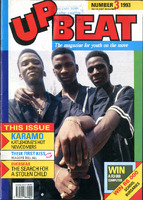 When is the right time to have sex? Upbeat receives hundreds of letters from young people around the country, asking this question. People tell us how confused and frightened they feel. It is a very difficult question and Upbeat doesn't have the answer. Maybe your friends are 'doing it' and you feel left out. But don't rush into anything that you are not sure of. Rather wait than make a big mistake. We've an article on page 14, to make you think about whether you are ready to have sex or not. We hope it helps you make the right choice. There are lots of great stories to read in this issue. On page 4 you can find out what is happening in the troubled schools of Soweto. Read an amazing story about Argentina on page 10 about young boy who was stolen. It is a story about courage - the courage of women who stood up and demanded that the government find their children. This issue is also packed with lots of things to win. We've got FIVE great competitions that will get you thinking, drawing and making things. Don't miss the competition for an ISM computer on page 20, or the school bursaries competition on page 36. There are also competitions for music and books.
 -
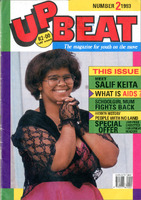
-
 On April 27, all South Africans will vote for a new government. Change often brings both hope and fear. We hope that the elections will bring peace and justice. But we fear that violence and intimidation will make democratic change difficult. It's up to us all to build peace. In this issue find out what The Peace Pioneers are doing and discover how to resolve conflicts peacefully in our story Fighting fair or foul'. But that's not all you must do. Be involved in the decisions that your parents, teachers and the politicians are making. Keep yourself informed! Ask questions when you don't understand what the politicians are saying. Be critical of the promises that they make. It's your life that they will control. This is a year of great change in our country. Listen, think and don't be without Upbeat. We'll keep you informed, give you advice and put your views - the views of the youth of South Africa - first.
 -
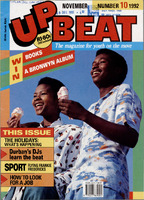 The days are getting longer and warmer. It is almost holiday time. This year, there is no need to sit around feeling bored. There are lots of exciting events for young people in the December holidays. Many youth feel that places like museums and art galleries, aren't for them. But they are for everyone. Learn to paint t-shirts or to do beadwork. Attend a workshop on photography or spend an afternoon learning to be a DJ - mixing and scratching records. Find out about all these exciting holiday events on page 36. Upbeat has also organised Upbeat Days. We've got together with schools and resource centres around the country. There will be clean-ups and plays, beach walks and treasure hunts, food, fun and great prizes to win. Why not write a story for Upbeat during the holidays? Spend a day being a reporter. If we publish your story, you will be R30 richer. Find out how to be an Upbeat reporter on page 7. Here's another holiday idea! Put your feet up and spend the afternoon enjoying reading this issue of Upbeat. Read about Bronwyn, the young local teenage star. Wangari Maathai is a tireless and brave woman from Kenya. Don't miss her story on page 4. Have fun making a mask. Or try and find your way through our mind-boggling maze. Reading and learning is always fun with Upbeat!
 -
 Far away in Canada, young, disabled people 1 are getting together. Erinoak is a centre which helps young people with disabilities. A group of young people decided they wanted to speak for themselves. So they started the Youth Advisory Committee or YAC, as they call it. Upbeat spoke to Jennifer Thompson, a committee member of YAC. Jennifer is 19. 'I joined YAC two years ago,' said Jennifer.'YAC has made a big difference to my life. It helped me to make friends. People in the group gave me support and I got a chance to help others,' she said. YAC meets once a month. We asked Jennifer what they do. 'We organise social events for young people with disabilities. We show movies and help teenagers get together. We also have a newsletter. YAC has helped me to build self-confidence. It taught me what I am able to do. It has made me feel good about myself,' said Jennifer. Jennifer is not the only person who thinks that YAC is great. Annette Symanzik had this to say. 'YAC is a special group for me. It gives me a place where I feel I belong. At YAC I am able to talk to others who have different disabilities. I liked all the events YAC did this year, especially the fun fair, the dance and the panel discussion,' she said. GOING TO SCHOOL In South Africa disabled children attend special schools. But in Canada disabled children go to school with other children. Jennifer attended a local school from the time she started nursery school. 'I had no real difficulties at school,' Jennifer told us. 'The other kids at school were always great. I am glad I was integrated in the school system. But sometimes it is very hard to deal with people who have a negative attitude towards my disability,' she said.
 -
 Forte High School in Dobsonville, Soweto has closed down. Students told us what went wrong.'Schooling was normal until hostel dwellers started bothering us. They did not want students to walk past the hostel. But the hostel lies between our school and the township,' explains Thapelo Mohapi, a Std 8 student from Forte. Masego Sekelema was also a student at Forte. 'In March, the hostel dwellers attacked our school,' Masego said. 'Police came in. We thought they would stop the attack. But they shot teargas into the school. One of our students was seriously hurt.' So the principal of Forte called a meeting. At the meeting people agreed that Forte should close. Students' lives were in danger. Since then, Forte students have been attending school at three primary schools in Molapo. 'This arrangement is better than nothing,' said Florence Smith who is in Std 9. 'But we find it difficult to travel so far and it costs our parents money.'
 -
 On 7 August, more than 6 000 teachers from all over the Transvaal gathered in Johannesburg. The teachers wanted the government to know how difficult teaching is when there are no proper facilities. The teachers met at the City Hall to talk about their problems. Then, at one o'clock, everyone left the hall and marched to the Department of Education and Training offices in Braamfontein. Down Rissik Street the teachers marched, right past the Upbeat offices. All you could see were teachers, teachers and more teachers. When they reached the DET offices, they gave the DET a list of their demands. This is what your teachers want. The DET must recognise the teachers' union, SADTU. The DET must stop making the lives of teachers who belong to the union difficult. All teachers must earn a living wage. There must be smaller classes and more teachers. All schools must be open to all people. Women teachers and girl students must be treated the same as males. All education laws to do with apartheid must go. The DET must confirm the jobs of all teachers on probation.
 -
 In July this year, 180 rural communities in the Natal Midlands received very good news. For more than 40 years the government has threatened 160 000 people living in Matiwane's Kop, Steincoalspruit, Cornfields, Stoffelton, Roosboom and Thenbalihle with forced removal. The government told them that they couldn't live there. This area was for whites only. But the communities said they wouldn't go. They had been living in this area for many years. In fact, their families had been living there for more than 200 years. So they decided to fight to stay. Early this year, community leaders met in Pietermaritzburg. They launched a campaign against the forced removal. They also sent a long letter to the Minister of Cooperation and Development. A few months later, the community leaders announced their victory to their communities. The government had backed down. They were not going to force the people to move.
 -
 A policy statement outlining COSATU's long-term campaign for the democratisation of mutual insurance companies (Old Mutual and Sanlam). It argues that while these companies manage vast sums of worker provident fund contributions, workers are granted no real ownership or governing rights. The document proposes that organised labour be represented on governing structures through Nedlac and that the resources of these "Mutuals" be leveraged for national economic development.
 -
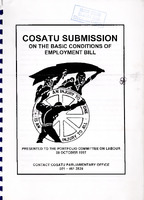 A 64-page formal submission to Parliament regarding the Basic Conditions of Employment Bill (BCEB). It tracks the transition from the 1996 Green Paper to intense negotiations in NEDLAC. COSATU argues for a mandatory "floor of rights" for all workers, especially domestic and farm labourers, while critiquing business attempts to maintain "apartheid cheap labour practices" under the guise of international competitiveness.
 -
 A discussion document reflecting on the role of COSATU following the 1994 elections. It acknowledges the sympathetic nature of the new ANC-led government while emphasising the need for COSATU to maintain its "high moral ground" and organisational strength. The paper outlines a "Back to Basics" approach, focusing on the core union functions of collective bargaining, the living wage campaign, and meeting the basic needs of workers.