
General Materials
Item set
- Title
- General Materials
- Alternative Title
- LRS General Materials
- Creator
- Labour Research Service (LRS)
Items
-
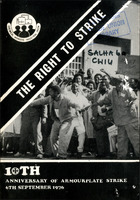 In South Africa and throughout the world the working class is struggling to win the full right to strike. This booklet is published to commemorate the 10th anniversary of a landmark in this struggle under Apartheid. Ten years ago, on 6th September 1976, members of the Glass and Allied Workers Union at Armourplate went out on strike. The first legal strike by black workers. Although their brave struggle was not successful then, many lessons were learnt that have allowed victories to follow. Such lessons were put into practice in the Dunlop strike and the sit-ins covered in this booklet. The legal position of strikes is confusing and part of this booklet tries to clear this up. The present legal rights can be compared with our demands in the COSATU resolution.
 -
 One will assume that the topic chosen for me to present a paper on,is no the one which looks on organisational and analytic development of TGWU. I will therefore focus on TGWU 's perspective on the current bus crisis future perspective and TGWU organisational role in the bus industry I felt it important to outline a brief background and our perspective cm the industry and how that dictates our attitude towards the industry. This paper is divided along the following sections;- Use of transport in internal economic and labour control. Contradictions and conflicts over transport policy. The future and its implications for Transport policy after apartheid. TGWU's organisational role and influence in the industry.
 -
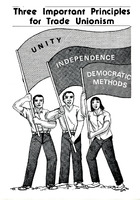 The first principle of trade unionism is unity: the unity of workers, or put another way, solidarity, “one for all, all for one. With solid unity, many things can be achieved by the workers. Without unity, nothing of significance can be achieved by an individual worker. What this means in practice is: the organizational objective of a union is 100 percent membership.The strength and influence of a trade union in its relationship to employers depend on the extent the employees of the company concerned are unionized. The higher the proportion of unionized workers to non-unionized workers, the greater the strength. Apart from numbers, strength also come from organizing the key, skilled workers in the enterprise. Depending on what the basis of organization of the union is—whether it be craft occupation, a specific industry, an undertaking, a common employer or general labor —all workers should be united into one union, irrespective of race, religion, creed, sex, skill, etc. All are equal in the eyes of the organization. Trade unions should also operate nationally because local or regional unions cannot develop sufficient bargaining power or competence over a whole range of issues to adequately safeguard the interest of workers. Trade unions should not be considered as closed societies. They should not be an instrument of privileged or elite workers, jealously guarding member's privileges against nonmember workers who receive lower wages and are unorganized. They should be open to all workers, otherwise, these same underprivileged workers could be used as scabs against organized workers in the event of a serious conflict. If an organization is to serve the needs of its members, it must be controlled by the members themselves, for who but they themselves can best define and guard their own interests? If a union intends to truly achieve the principles and objectives upon which it was founded, it should not allow itself to be dominated or controlled by external interests, be it government, employers, political parties, religious, communal or fraternal organizations, or individual persons. A government may or may not be well disposed to trade unions, but in general, it is very responsive to the interests of the powerful groups in society, usually the employers. Moreover, if a government can control the operation and policies of a trade union, it becomes an instrument of the government rather than of the workers for whom it was originally set up. There are cases where a so-called “union†is organized by the employer for the employees. This kind of union is a “yellow union†(company dominated union). It is dominated by the management or its stooges. It is usually a local union (or a one-shop union), which means that only employees of that undertaking are allowed to join it. Needless to say, this kind of union is totally useless because its basic purpose is not to promote the workers' interest but to prevent them from setting up a genuine one. When management starts to pressure employees to join a local union, the signals are clear: it is a yellow union. Equally, the union should resist any attempt by any political party to control and dominate it. The interests of the political party are not necessarily the same as those of the union. Even if there are some areas of shared interests, the ultimate aim of a trade union is to serve its members. This aim may be distorted under the domination of a political party whose basic aim is to obtain support from all sectors to secure power.
 -
 Last week, SAMWU held lunchtime demonstrations around the country to protest against the privatisation of municipal services. The demonstrations were well attended with reports from the regions indicating that thousands of workers turned out. SAMWU has received an overwhelming show of solidarity from the international community. The General Secretary of UNISON, Britain's largest public sector union with over 1 million members, wrote that “The UK experience of water privatisation has been huge windfall profits for the companies, record dividends for their shareholders, and massive pay rises for those at the top of these companies. At the same time, employees have suffered job losses, while consumers have had massive price rises. Drought restrictions are widespread and almost one third of all water leaks from old pipes.†The Community and Public Sector Union is Australia wrote that “the Victorian government has pursued similar policies since its election in 1992, and this has resulted in the loss of over 30 000 jobs. Despite the massive effort at privatisation, the state remains the highest taxed state in the nation!†The President of the Public Services Association in Trinidad and Tobago wrote “Our own experience is that Severn Trent of the UK has been granted a loan facility by our government to cover all operational losses for the three year period, thereby taking no risks and collecting management fees of millions of dollars. Water is the most essential commodity for humans and it should never be handed over to the private sector profiteers.†The Executive Committee of Algemene Onderwijsbond, Netherlands wrote: “the evil of privatisation of public holdings is a worldwide problem.. .be convinced of our solidarity and support with your struggle.†SINTAP, the Portuguese Union representing public administration personnel wrote: “We hope the Ministry of Constitutional Development will be able to accept your pilot projects for public sector alternatives to privatisation of water and waste services.†The International Secretary of the 1.3 million member AFSCME (American Federation of State, County and Municipal Employees) wrote: “given its central importance to sustaining life, water must remain in public hands. We applaud your actions to ensure working conditions for those employed in these critical public services and your leadership in educating the community of the danges associated with privatisation.†The President of the Lithuanian Trade Union Federation of Public Services faxed SAMWU's President a message saying that “in Lithuania, the capital city of Vilnius has been fighting French multinational Lyonnaise Des Eaux for four years. They want to buy our city's water system for 5 million US dollars and get 30% of the shares, which is valued at 660 000 US dollars. Its profit the company will get from our citizens pockets.â€
Last week, SAMWU held lunchtime demonstrations around the country to protest against the privatisation of municipal services. The demonstrations were well attended with reports from the regions indicating that thousands of workers turned out. SAMWU has received an overwhelming show of solidarity from the international community. The General Secretary of UNISON, Britain's largest public sector union with over 1 million members, wrote that “The UK experience of water privatisation has been huge windfall profits for the companies, record dividends for their shareholders, and massive pay rises for those at the top of these companies. At the same time, employees have suffered job losses, while consumers have had massive price rises. Drought restrictions are widespread and almost one third of all water leaks from old pipes.†The Community and Public Sector Union is Australia wrote that “the Victorian government has pursued similar policies since its election in 1992, and this has resulted in the loss of over 30 000 jobs. Despite the massive effort at privatisation, the state remains the highest taxed state in the nation!†The President of the Public Services Association in Trinidad and Tobago wrote “Our own experience is that Severn Trent of the UK has been granted a loan facility by our government to cover all operational losses for the three year period, thereby taking no risks and collecting management fees of millions of dollars. Water is the most essential commodity for humans and it should never be handed over to the private sector profiteers.†The Executive Committee of Algemene Onderwijsbond, Netherlands wrote: “the evil of privatisation of public holdings is a worldwide problem.. .be convinced of our solidarity and support with your struggle.†SINTAP, the Portuguese Union representing public administration personnel wrote: “We hope the Ministry of Constitutional Development will be able to accept your pilot projects for public sector alternatives to privatisation of water and waste services.†The International Secretary of the 1.3 million member AFSCME (American Federation of State, County and Municipal Employees) wrote: “given its central importance to sustaining life, water must remain in public hands. We applaud your actions to ensure working conditions for those employed in these critical public services and your leadership in educating the community of the danges associated with privatisation.†The President of the Lithuanian Trade Union Federation of Public Services faxed SAMWU's President a message saying that “in Lithuania, the capital city of Vilnius has been fighting French multinational Lyonnaise Des Eaux for four years. They want to buy our city's water system for 5 million US dollars and get 30% of the shares, which is valued at 660 000 US dollars. Its profit the company will get from our citizens pockets.†-
 In South Africa, like all other capitalist societies, workers are forced to work for wages to buy the things they need to survive. The land, factories, mines, etc are privately owned by the capitalists. Because the capitalists own the land, factories and mines they control the wealth that is produced. With this wealth, as well as with the ownership of several newspapers and investment in radio and television stations, the capitalists can try and influence how people think. The capitalists also use the political rights and the wealth they have to influence how the government behaves. In South Africa, black workers have no political rights, because of apartheid. So they cannot influence the government in the same way as the capitalists. Workers standing on their own are also weak against their employers because the employers do not need any one particular worker. But the employers cannot do without all their workers. Machines without workers are useless. So if all workers can organise themselves to act together, to act collectively as it is called, then the balance of power changes. Capitalism needs the labour of workers to survive. So organised workers can be the most powerful weapon against capitalism. But the capitalists in South Africa are very powerful. They have a good friend in the apartheid state. Workers need to be well organised to challenge the power of the capitalists. But to build this strength, we need unity. We also need discipline and clear direction. The first step in making a union strong is for the union to have a very large membership. But the members cannot be sleeping members. They must understand the broader aims and objectives of the union and how the union fits into the wider struggle in South Africa. They must also have the skills and knowledge to be able to participate actively in all the activities of the union. Democratic practices increase the strength of workers' organisations and make them more effective. Democratic organisations are also necessary for building democratic societies because they make it possible for the masses of the people to participate in decisions about their lives.
 -
 This research report investigates changes in working time in the retail sector in the 1990s in the broad context of the extension of trading hours, the deregulation of the distribution of goods in the South African economy and the resulting intensification of competition in the sector. The research data that forms the basis of the analysis comes from two surveys undertaken by the author in the course of 1996. The first was conducted in the Cape Town branch of the South African Commercial, Catering and Allied Workers' Union (SACCAWU), which gave detailed information on working hours, employment practices and conditions (hereafter referred to as the “Cape Town surveyâ€). The second survey was a questionnaire sent in November 1996 to Human Resource Managers of 51 of the larger retail companies in clothing, footwear, jewelry, furniture, general merchandise, and miscellaneous markets (hereafter referred to as the “retail surveyâ€). Although the response rate was very poor (only 7 companies responded), the information from the replies is nevertheless informative. The report begins with an account of the deregulation of retailing that has taken place rapidly from the late 1980s onwards, part and parcel of the shift in political power. For important sections of the formal retail trade sector, competitive pressures have increased significantly increased by this development. Employers have reacted by attacking wage costs, which has led to a change in the forms of labour contract in retailing towards insecure, “flexible†part- time or fixed term contract work, and a decline in the influence of trade unions in the sector. These developments form the environment for the report's focus on working time issues in retailing. The report examines the existing regime of working time for the retail trade sector as determined by Wage Determination 478 for the Commercial Distributive Trade. It assesses the impact on the Wage Determination of the current proposals and approach in the Employment Standards Bill, which will likely pass into legislation in some form during the current session of parliament. The paper analyses the Bill's proposals for flexible working time standards, and concludes that they contain several problematic clauses that would hamper trade union efforts to secure a positive outcome to flexible working time innovations in the retail sector. The data from the Cape Town survey is used to illustrate the normal working time patterns in retail based on the Wage Determination, and shows that working hours are generally longer than 40 hours per week for full-time permanent workers who work a 5.5-day week. Furthermore, weekend and evening trading is covered by “flexible workers†working various kinds of “non-standard†contracts. The national employment and output profile of the sector is then examined through official statistics. They show that total retail sector employment reached a 40-year peak around 1988/9, it has since declined, despite the continuous increase in total retail sales during the transition from apartheid to democracy. Full-time “regular†or full-time employment has remained static in the sector since 1988, and the number of full-time equivalent posts has similarly been static. “Flexible†jobs such as part-time, “late salesâ€, and casual jobs have however fluctuated quite widely over the same period, from a low point of around 12% of total employment in 1988 and 1994, to high points of 25% in 1989, and 16% in 1994. The overall pattern is one where flexible labour is used by employers to manage variation in demand over the working week, seasonal variation during the working year, and longer-term business cycle fluctuations, such as the period of limited economic growth since 1994. Measured as the ratio between total retail sales and total employment, labour productivity increased over the period 1988-1995. Using the data from the retail survey and the Cape Town survey, the relationship between extended trading hours, turnover, and flexible labour contracts is examined in more detail. Weekend trading accounts for a very significant proportion of retail sales, and various forms of casual contracts take up between 20% and 50% of available labour contracts in the companies concerned. For some companies, new stores are now designed around only 30% “core†permanent staff, with the other 70% of contracts being “flexibleâ€. A situation has therefore developed where full time “regular†workers are working relatively long hours (standard 45 per week + overtime), but are increasingly being supplanted by flexible workers with much shorter hours, poor pay, poor job security, and few (if any) fringe benefits of employment. This also undermines the bargaining position of trade unions in the industry, as bargaining units shrink. Because of the strong feelings of workers around reduction of working time to 40 hours, impending legislation on the issue, and the strong relationship in the industry between flexible labour, extended weekly trading hours, and seasonal variations in consumer demand, the issue of working time offers an opportunity to retail unions to make gains in shorter working hours, job creation, and employment security, if they can accept flexibility of working time for their established constituency. Innovations in working time such as “chosen time†and flexible working schedules need concerted attention from retail unions to prevent employers from controlling working time and employment contracts. Success depends on the degree to which unions can force employers into centralised bargaining. The paper looks at the failed attempt by SACCAWU to gain a centralised bargaining forum during 1996, which would have been an ideal instrument to address the issues around working time. This suggests that the best strategy for unions now is to concentrate on the struggle over the reduction of hours around the employment standards statute, and work on a “model†agreement with a large national employer, which can then be imitated with other employers, and then in a future centralised bargaining forum. The report then looks at examples where this opportunity has been exploited internationally, and there have been some trade union successes in company level bargaining. These examples combine job creation with reduced working hours, and some choice for workers over what hours they will work within the overall pattern of extended trading hours. The 1986 guidelines on flexible working time from the European retail workers' federation are examined, and are recommended as still a useful approach for the South African retail unions in the mid-1990s. The report ends by looking at contemporary workers' experiences of working time in South Africa at shop level as revealed by the Cape Town survey. The main barriers to workers accepting flexible working time are examined: these include problems of transport (and personal security), and child care. The section also assesses the way in which employers have maintained control over working time alterations at shop level to date. There is some interest among workers in shorter working hours - even with loss of some earnings - as well as changes in starting and finishing times of work. However, attempts by workers to negotiate favourable changes with their employers are usually unsuccessful, whereas unilateral changes in working time made by employers are more common.
 -
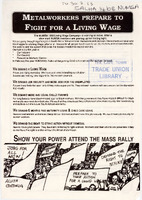 The NUMSA 1990 Living Wage Campaign is starting to move. After a slow start NUMSA members are gearing up for the big fight. We are going through big changes in South Africa. We want to tell the bosses and De Klerk: the workers will never end the struggle lor a Living Wage, jobs for all, houses for all, proper health care for all. De Klerk must meet our demands. We want to end the system that gives the bosses freedom to exploit workers. Our battle cry this year is: Our Industry, Our Country, Forward to Workers' Control. In February this year NUMSA/Es National Bargaining Conference set-out the workers demand.
 -
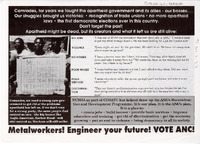 NUMSA as part of COSATU has helped draw up the ANC's Reconstruction and Development Programme. It is our plan. It is the ANC's plan. It is a plan to: • create jobs • build houses • provide basic services • improve education and training • get rid of discrimination • get the economy growing • put an end to violence • bring democracy to all in society. Comrades, we need a strong new government to get rid of the problems apartheid has left us. If we don't vote for a strong party, the same people that control us now - the big bosses like Anglo American, Barlow Rand - will still control us. Workers will still suffer.
 -
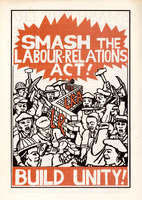 The South African state is facing a serious political crisis. Apartheid policies have been decisively rejected by the majority of citizens. The state is only able to retain power by force; by the declaration of the state of emergency, by detentions, by putting the SADF in the townships and by suppressing all opposition. These measures will eventually be defeated. But the state and the ruling class also face a critical economic crisis. This is linked to the political crisis. The capitalist class is trying to solve the economic crisis by squeezing even more profits out of the working class. To do this the capitalist class needs to keep wages down and to replace more and more workers by machines.
 -
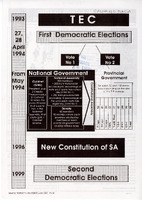 Every member is free to join any political party. NUMSA will encourage its members to vote ANC because it wants a strong government to fix up the country's and workers' problems. NUMSA members must not force anyone to vote for the ANC or any other party. NUMSA members must be free to vote (or not vote) for whoever they want. It is your right to vote; it is also your right not to vote. BUT you may not force anyone to vote or not vote. Voting stations will be in places like schools, community halls. Ask and discuss with your fellow workers, ask at NUMSA or COSATU offices, listen to your radio, look for posters and pamphlets nearer election time to find out.
 -
 It is a welcome move that the Minister has ordered an investigation in the security services within 2 years of the last amendment which was in November 1977. Regular adjustment to minimum wages ere imperative in a situation of rising cost of living. In the past an interval of about 4 years have lapsed before a new investigation is begun. Another positive aspect of this investigation is that the conditions are being investigated simultaneously throughout the major industrial areas in South Africa. This will help in bringing about a uniformity in the conditions of a group of employee 3 who ail do basically the same type of work. It is regretted that the scope of the investigation only includes undertakings in which employers and employees ere associated for the purpose of guarding, protecting etc. In she past this has meant that a large group of security guards are left out completely from the purview of the investigation and are hence not covered by any industrial legislation especially in regards to hours of work.
 -
 The FEDUSA Parliamentary Office provides legislative support to the affiliate members in the form of outputs ranging from publishing National Executive Reports, preparing and presenting oral and written submissions to the parliamentary portfolio committees in National Parliament as well as the publishing of a parliamentary affiliate newsletter on newsworthy issues being discussed in Parliament. A Bill Profile which serves as a reference document includes profiles of all legislation tabled in National Parliament, as well as monitoring and tracking progress through Parliament. The Bill Profile is an interactive service available through electronic media to all affiliate members.
 -
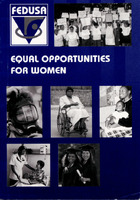 Over the last thirty years, there has been considerable evolution in the thinking about gender equality issues and the actions needed to achieve real changes in the position of women vis-a-vis men. Prior to the 1970s, women were defined mainly in terms of their conventional reproductive roles, and efforts to improve women's welfare focussed on such programmes as literacy courses, home economics, child care and family planning. Though no doubt valuable, such welfare and family-oriented programmes had the effect of reinforcing women's traditional role in the family. Since the 1970s, there has been a shift to the division of labour based on sex, and the impact of development and modernization strategies on women. It is important to understand that improvements in women's status require analysis of the relations between men and women, as well as the concurrence and cooperation of men. As illustrated in the Beijing document: "Achieving gender equality and empowerment of women requires redressing inequalities between women and men and girls and boys and ensuring their equal rights, responsibilities, opportunities and possibilities. Gender equality implies that women's as well as men's needs, interests, concerns, experiences and priorities are an integral dimension of the design, implementation, national monitoring and follow-up and evaluation, including at the international level, of all actions in all areas."
 -

-
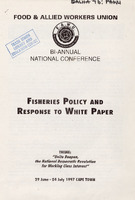 This paper is intended to serve as an aid to discussion in the Commission dealing with Sea Fisheries. Accordingly, its various sections provide an overview of the key issues which can inform discussion. Historically, access to marine resources was unrestricted. In order to facilitate the monopolisation of the fishing resource by a few white companies, a system of quotas was introduced. In this way many black fisher folk lost the access rights they had had for generations. At the present time, the fishing industry is completely biased in favour of a few large and medium sized white companies. This is illustrated by the fact that just three (3) companies hold;72% of the hake quota ;75% of the abalone quota , and 71 % of the sole quota. Overall , across all species, approximately nine tenths (9/10) of the resource is controlled by a hand-full of companies. Since 1994, some of these companies have attempted to blacken their faces. They have also sold minority shares to some, black business consortia. Further, a few members of the black elite have been given quotas. None of the above amounts to any kind of restructuring. None of the historic imbalances have been addressed. The above have merely been attempts to confuse the issue and to frustrate any process that attempts to restructure the industry. Prior to, and after the 1994 election, there were various initiatives by Alliance members to outline an equitable and just policy of reconstruction and development for the fishing industry.
 -
 The two-hour drive from Cape Town to Worcester is long. But it's not boring. You pass green, open farmlands where cattle graze. Every now and then, you cross a river or a stream. In the distance, the purple mountains frame the blue sky. Bree River High School In the valley surrounded by the Hottentots-Holland mountains, you find Worcester. Just outside the town is Bree River High School. Wilfred Zebedezela is a student there. He throws the shotput. He lives on a farm outside Worcester and he travels for an hour everyday to get to and from school. 'At school there isn't a place where I can train with weights, said Wilfred. 'So I build my muscles by doing farm work. I would like to practice shotput at home, but I can't because there is only one shotput at school. I can't practise at school, as there is no teacher to stay behind in the afternoons with me.' Ruduwaan Visagie is a 200 metre sprinter. 'We can't afford things like starting blocks. We ran in the South African Junior Athletics Championships. But some of our athletes almost couldn't take part. We didn't have starting blocks. Fortunately, we managed to borrow some.'
 -
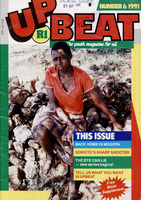 The people of Paballelo in Upingtonhadabig party. They started celebrating on Thursday 30 May and they carried on right through the week-end. They were happy because their friends were home, home from death row in jail. Perhaps some readers will remember reading a story in Upbeat last year about Evelina de Bruin. She was one of the people from Upington on death row. She was also one of the people set free on the 30 May. The first thing that Evelina did when she stepped out of prison was to hug her children that she had missed so much. 'I feel the same now, seeing my children as I did when I saw them for the first time as newborns,' said Evelina. Next Evelina gave her husband, Gideon Madlongwane a big hug. Gideon had also just been freed from death row. Evelina still says she was innocent. 'I heard about the death of the policeman while I was doing my washing,' said Evelina. 'I was shocked when I was arrested. But I was not afraid. I knew Gideon and I had done nothing. I never dreamt that we would spend three and a half years in jail.' Evelina's lawyers are happy and angry. They feel that she shouldn't have gone to jail in the first place. But they are happy that their appeal against the death sentences of the 14 people from Upington has been overturned.
 -
 Richard is in Std 9. He sits in the same row as Thabo and Mike. They are his great friends. Every day at break they sneak out the schoolyard to go and smoke dagga. Richard doesn't like smoking. He wants to say no. But he is scared his friends won't like him if he does. He doesn't want to risk that. These are his chommies! They all watch soccer together and share secrets about girls. Maybe you find yourself in Richard's position. You are also too scared to say no to your friends. Try to be brave and stand up for yourself. Tell your friends that you don't want to smoke, because drugs are harmful. You may be surprised to find that someone else in the group agrees with you. He was just too scared to say so. Or maybe your friends will cut you out. You'll feel lonely for awhile but others will come to respect you. We all look up to people who make a stand. It is hard to go against your friends. But you must learn to do what's right for you. Arm yourself with information. Read, listen and learn. Then make your choice. Upbeat is filled with important information to help you make decisions about your life. In this issue read why Prophets of the City say No to drugs. Don't miss our hot debate on sex education. We've got information on AIDS. So tell your friends about it and help stop the disease spreading. We all love listening to music. But do you know how a record is made? Find out all about the recording industry on page 17. That will really impress your friends! When they look surprised and say 'how do you know all that', just say you read it in Upbeat. You'll be a winner at parties.
 -
 Conflict is OK. Violence is not! You can disagree with someone else's views. But you can't punch them! Conflict is a normal part of life. We are all different and want different things. As a result we often fight with the people around us - our family, friends and neighbours. You like rap but your boyfriend likes disco. You want to go out but your mom says stay at home. Every day Upbeat receives lots of letters from our readers. Many of the letters are about violence. There are stories about violence in the street and poems pleading for peace. There are letters seeking help in solving battles with boyfriends and parents. Readers tell us frightening tales about violence between gangs at school and students who hold different political views. The problem seems too big to solve. You may think our leaders should sort it out. But we can all do something to help build peace in our country. In this issue we start an exciting new series called 'Be a peacemaker'. It is about how to tackle conflict without screaming, blaming or punching the person you are fighting with. Learn to be a peacemaker at home, school and in your community. YOU can make a difference. You can't avoid conflicts in your life. But you can learn to 'fight fair'. Don't forget! If you have ideas that you want to share or a story to tell - write to us. If you need advice on careers or sex education - let us know. Sometimes all it takes is a little bit of advice and information to make you feel better and get you on the move again.
 -
 On the night of the 8 March 1991, a thousand women braved the rain to march through the streets of Johannesburg. They chose this day for their protest march because the 8 March is International Women's Day. The women marched to highlight the problem of violence against women. They said that women are not safe on the streets at night. Many women are not even safe in their own homes! The night they marched about 140 women were raped in South Africa between six and nine o' clock. Many women were beaten and raped in their own homes, some were hurt by their own husbands or boyfriends. 'We want to feel safe in our own homes, at work and in the streets. We demand an end to violence against women,' Monique Marks of the ANC Women's League said. Copies of the demands were sent to the Chief Magistrate of Johannesburg, the City Council and Health Department.
 -
 There are two sides to every story. You've surely heard that before. Well, it is true. Sometimes there are even three or four sides to a story. It depends how many people were there to tell the tale. Behind every story there is a writer. Behind a picture there is a photographer. And they are ordinary people, like you and me. They eat, sleep and play like the rest of us. Like us, they have their own ideas and feelings about the world. And these ideas show in their stories, books or photographs. So what you read is not the truth. It is someone's version of it. Always read with an open mind. Be a detective when you read! Ask questions, think, search for clues and weigh up the facts. Then decide for yourself which story comes closest to the truth. You must have learnt about Christopher Columbus at school. Well there's another side to that story in our article called 'Who discovered America?'. Read it and decide what YOU think really happened. Upbeat writes a lot about young peoples' experiences of growing up. There's another side to being a teenager - being the mother of one. Nomasondo Hadebe openly shares with us the pain and joy of having teenage children. We don't only learn from grown-ups or famous people (or both). Upbeat is full of stories about youth, their ideas and feelings about the world. By sharing experiences, problems and ideas we can learn from each other. So don't miss our letters page, advice column and talkshop. Read what young people have to say. You can agree or disagree with their ideas. And when you close the magazine you may feel a little sadder, happier or angrier. But you will always be wiser
 -
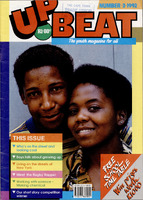 Teenage life is full of challenges.' That's what Ebrahim Abader from Cape Town thinks. He's right. When you are young there is lots to learn and discover about yourself and the big world out there. It's exciting! But it can be a miserable time too. It is not easy to meet a challenge when you are worried about pimples, can't do your maths and are suffering from a broken heart. You are special but you are not alone. Young people all over the world are probably going through what you are. Believe it or not your parents and teachers where once teenagers too. Ask them what it was like. There is a big challenge facing all of us, especially young people in South Africa today. We have to learn to live together; to accept differences and respect one another's feelings and beliefs. It is called tolerance! Your parents, brothers, sisters, comrades, neighbours and friends have their own ideas. Listen to them with an open mind. In this issue you can read about a great school in Tongaat in Natal. Here students have learnt to forget about colour and together are discovering what real learning is all about. Meet Simon Nkoli. He knows what it's like to be treated unfairly and to grow up feeling different and alone. So readers, speak out, listen, read and learn. That's the way to get wise. That's the way to meet the challenge of being a teenager in South Africa today. Some of you may be writing supplementary exams. Go for it - you can do it this time! We are holding thumbs.
 -
 It's tough being a teenager. There's pressure from all sides - your friends, parents and teachers. You've got lots of questions that no-one will answer. If you want to get on top of your world, don't be without Upbeat in 1992. This year Upbeat is bigger, brighter and better than ever. There are more pages, more competitions, music and fashion. And the good news is you can find us everywhere - on the street, in your corner shop or in the CNA. We also have special offers for teachers and students. Subscribe before April and you could win prizes worth R1 000. Upbeat also helps you with your school work. But it's not like learning in school. This is learning with a difference. We open your eyes to the world around you. In this issue we'll take you to a night club in Cape Town where everyone is 'hipping and hopping.' Meet a young girl in a faraway land, most of us know nothing about - Pakistan. For comic lovers there's our action packed comic 'Taxidriver'. Follow the adventures of Kabu a taxidriver from Sekhukhuneland in the Transvaal and learn all about South Africa in the 1950s. It's a great way to learn history! No issue is too hot for us to handle. In this Upbeat young people share secrets about their relationships. Our advice page answers your questions on sex education and careers. We believe young people in this country need a voice. Each issue is packed with poems, stories, news and views of young people around the country. So here's your chance to tell the world what you think, express your true feelings in a poem or ask those questions grown-ups don't like to answer. Write to us, it is your magazine. Upbeat is for teachers too. Lots of teachers around the country use Upbeat to promote a different kind of learning in their classes: learning that gets students thinking, helps them understand their world and most of all that's FUN. Read how Mrs Naylor a teacher from Cape Town uses Upbeat with her students. Finally, did you know you have rights? The right to be heard is just one of them. The Rights of Young People is the theme of our calendar this year. And it's FREE in this issue for you to put up on your classroom or bedroom wall.
 -
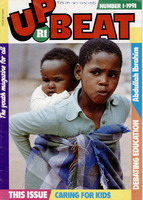 Every day we see adverts in newspapers and magazines encouraging people to smoke cigarettes. But what these adverts don't tell us, is that smoking cigarettes is very dangerous. Today there are 75% more smokers worldwide than there were 20 years ago. Doctors in America are very worried about the damage smoking can do to one's health. They say that smoking is responsible for almost 2.5 million deaths every year. More and more children are starting to smoke cigarettes. Doctors say that millions of children under the age of 20 could die of smoking.
 -
 Where is Maputaland? It is in Northern Kwazulu/Natal. For many years, the government ignored far away places like Maputaland. The roads are terrible and there are few buses. People must walk a very long way to get to a clinic or a shop. The people of Maputaland wanted to solve their transport problem. So they got together with the Khuphuka Skills Training and Employment Programme. Khuphuka is training local people to build drains, roads and bridges. In the Ingwavume and KwaNgwanase districts, 36 young men and women are training to be team leaders. While they work, they are being taught all about how to build roads. When they graduate from the course, they will supervise other trainees. The project is part of the Reconstruction and Development Programme and is co-ordinated by the Department of Public Works.