
General Materials
Item set
- Title
- General Materials
- Alternative Title
- LRS General Materials
- Creator
- Labour Research Service (LRS)
Items
-
 This document has been written to inform Deputy President Thabo Mbeki of FAWU's objections to the above-mentioned White Paper. It also includes FAWU's recommendations for changing the policy. The fishing industry in South Africa is an Apartheid creation. Like other aspects of our society, it needs to be completely transformed and restructured. Currently, the industry is marked by: Monopolised control of every aspect of the fishing value-chain: from production to processing to marketing to distribution; Highly restricted access to the resource by historically disadvantaged members of our society; and Disempowered communities who originally had unrestricted access to marine resources. The above conditions have been created by a process of systematically violating the human rights of fishers and fishing communities. A new White Paper on Fisheries has the potential to change this in a sustainable economic and environmental way. Unfortunately, the 1997 White Paper on Fisheries does not adequately address the legacy of history. In fact, there are more similarities in this Paper to the 1988 Sea Fisheries Act than there is to any framework of transformation. One such framework was put forward by the Fishing Policy Development Committee (FPDC). However, it seems that key aspects of the FPDC's recommendations were ignored. This is unacceptable.
 -
-
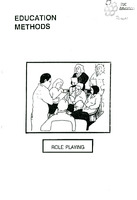 This note is a practical guide to what role playing is and how to do it on trade union courses. 'Role playing' is not just a method of education: it is something you do every day. One minute, you're a parent , seeing the kids off to school. Then you're off to work, and you're a driver, passenger, or pedestrian. Go to the branch meeting and you are a union activist. So in your daily life you take on a number of different roles, and get used to switching between them. Used properly, role plays can help you to run a lively, active, arid effective course. Role playing involves everyone, helps them to develop skills, and gives them practice in applying Information to problems. Because your course is a 'safe' environment where you do not pay a price for making n ml stake, a role play can give people confidence in trying out new ideas. So you could try to get participants to Improve the way they run union meetings; talk to members, management, or journal lets; or work on a negotiating team.
 -
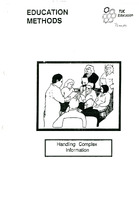 This note looks briefly at a key problem confronting trade union educators: how to handle topics which involve complex information. There are several different parts to this problem: The range of topics facing trade union educators is immense, and growing all the time. Safety, pensions, compulsory tendering, new technology, the list seems to be endless. Trade union education must develop an approach that allows us to take all these and other issues on board in an effective and rational way. Many participants on trade union courses don't have highly- developed 'information skills', such as looking up a reference book, using an index, or gutting a document for key points. There is a shortage of tutors with detailed knowledge of complex topics, and Of subject experts with educational experience.
 -
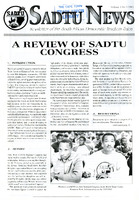 The Third SADTU Congress, held at the World Trade Centre in Kempton Park, was attended by over 800 delegates, representing 100 000 teachers country-wide. Delegates were elected at Branch level, ensuring grass roots participation in the highest decision making body of the Union. The Congress served to confirm SADTU's position as the largest teacher Union in the country, and demonstrated a strongly unified focus around the theme: “Unionise and Reconstruct for Teacher Empowermentâ€. The success of any Congress must be measured against the aims it sets itself. Our Congress had two aims: to elect new leadership for the next two years, and to adopt resolutions which would inform the direction and programmes of the Union in this period. While we successfully completed the former task, we could only make a start on the second aspect - confirming the fact that the period we are entering is far more complex than before, and in need of extensive analysis and debate. We therefore mandated the SADTU National Council to formalise the adoption of resolutions arising from the reports. A Special National Council was convened on 25/26 August, with extended participation by regions, and the Congress report can now be finalised.
 -
 NEGATIVE ASPECTS OF EXISTING JOB GRADING. Staff members do not have a stable basic salary. The basic salary fluctuate in relation to changes within the package such as medical aid , housing and car allowance. Financial Institutions base their credit assessment on the gross salary and not on the total package since other benefits do not form part of the cash received in the bank on pay day. This system encourage staff members to be able to cancel medical aid contributions and other allowances since one in return receives an increased basic salary at the end an increased cash in the bank . Blue collar employees are not benefiting from such salary structuring . Most of these employees have bigger families which adds more dependants at the end . These are staff members who earn low income . With this category of employees you find staff members who are frequently ill or offsick due to improper diet and poor living conditions or lack of proper medical treatment. Good heath is a basic need . Employers should have such salary systems which should encourage staff members to have medical aids in order to have employees who are in a good state of health . This should be the resposibility of the employer to encourage its staff members to be in a position of participating in medical scheme for a better output of the organisation and have a healthier society and a growing economy .
 -
-
-
 In the past, the government in many countries provided social welfare benefits to people. These benefits included things like public health care and free education. This is now changing in many countries. Governments today provide fewer services and benefits to people. Instead they hand this job over the private sector. This means that people have to start paying before they get a service. If families can't afford to pay private companies for these services, then someone in the family has to fill the gap. Generally it is women who have to: care for the sick when it is too expensive to take them to hospital, collect firewood because electricity is too expensive, walk miles to collect water from the river because piped water is too expensive. Many governments have been forced to change the role they play in the economy by the structural adjustment programmes (SAPs) that the International Monetary Fund (IMF) imposes on them as one of the conditions for lending them money
 -
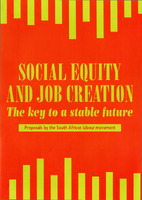 A comprehensive 1996 policy framework and economic vision released by organized labor (COSATU, NACTU, and FEDSAL). It critiques the "jobless growth" of the early transition and the extreme income inequality where the richest 10% earn over half the national income. The document advocates for a "social equity" model involving the redistribution of wealth, a "floor of rights" for workers, and an active role for the state in the economy, explicitly challenging the SA Foundation’s "neo-liberal" prescriptions.
 -
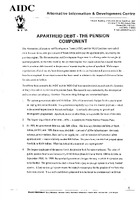 The Alternative Information and Development Centre (AIDC) and the NGO Coalition have called upon the new democratic government of South Africa not to pay the apartheid debt, incurred by the previous regime. The Reconstruction and Development Programme is suffering under the weight of interest payments on the debts made by the apartheid regime. Our organisations have argued that this debt is an odious debt incurred in the process of maintaining the system of apartheid. While major organisations of civil society have shown great interest in this issue, business and government circles . have been sceptical. A consistent concern has been raised in relation to the impact of debt cancellation for state pension holders.
 -

-
-
 There are two main co-operative activities that are supported by NUMSA. The one is SAWCO in Natal and the other is the project that is starting here in the East Cape. Does NUMSA have a policy on co-operatives? NUMSA in its Central Committee has taken a decision to support co-ops. But NUMSA is still busy thinking of how we can formulate a policy on co-operatives. We are working towards such a policy. So what is NUMSA's aim in giving support to co-ops? In other words, how can organised workers benefit from the support that NUMSA is giving to these co-op activities? Interview with Cde John Gomomo NUMSA East Cape Regional Chairperson We, the organised workers on the shop floor are becoming more and more mobilised and politicised. We do not believe that the struggle should just end on the shop floor. The struggle of organised workers should also benefit the community. Co-operatives is such an activity that can be of interest to all groups of oppressed people. We, the organised workers with all the skills we have gathered in the organisation, we believe that if we take the lead, co-ops could be fully democratised organisations in the community.
 -
 COSATU must intervene in affiliates where it has identified problems, where problems have been brought to its attention and / or has been requested to do so. The CEC should draw guidelines on how and under which circumstances the federation and its structures may intervene taking into account clauses 3.9 and 3.10 of the constitution. Such intervention should not undermine affiliates where such problems exist. COSATU leadership must be visible during major disputes between affiliates and employers and co-ordinate solidarity with workers involved in such disputes.
 -
 COSATU must intervene in affiliates where it has identified problems, where problems have been brought to its attention and / or has been requested to do so. The CEC should draw guidelines on how and under which circumstances the federation and its structures may intervene taking into account clauses 3.9 and 3.10 of the constitution. Such intervention should not undermine affiliates where such problems exist. COSATU leadership must be visible during major disputes between affiliates and employers and co-ordinate solidarity with workers involved in such disputes.
 -
-
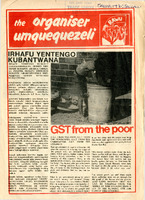 IRHAFU YENTENGO KUBANTU ABAHLUPHEKILEYO, IRHAFU YENTENGO KUBANTU ABADLA UMHLA- LA PHANTSI, ORHAFU YENTENGO KUBANTU ABANGAPHANDLE KWE- NGQESHO, IRHAFU YENTENGO KUBANTWANA' Urhulumente okhoyo usenkathazweni. Jikelele apha emhlab' uhlangeni ujongene nentiyo- yoluntu olufuna ukonyuswa jkwemivuzo, imfundo ephucukileyo, lizindlu eziphucukileyo, nokuthatha inkxaxheba kulawulo leli lizwe. Ngoku ephakathi koluxanduva uya kubani eyo- kucela uncedo? Akayi kongxowa-nkulu abamonyulayo nabenza izigidi ngezi gidi zemali ngenxa yemithetho awayi qulunqayo. Hayi uya kubasebenzi, kubantu abahluphekileyo asigunyanzise ukhuthi sihlawule iimpazamo zakhe. Urhulumente uzakutychitha entweni jyonke lemali yerhafu yentengo? Ingaba- bcthu uzakuyichitha ekusakheleni izindlu okanye uzakusinika ukutya nezinto zoku- Ihamba, kwimfundo mhlawumbi eyiyo lyabantwana bethu, abakhele mhlawumbi bindawo zokudLala nokonwaba? Hayi uza- gkuchitha kubandlululo nocalo-calulo! Uzakuyichitha kulo mgaqo-siseko mtsha lozama ukwahlula-hlula abantu bangabi nawo amandla okulwela amalungelo abo. Uzakuyichitha ngokugaya amapolisa lomeleze nomkhosi wokugcina ucalu- calulo nengcinezelo zomelele ukuze thina bantu bahluphekileyo sihlawule.
 -
 The publication of this Green Paper is the first step taken by the Department of Labour in developing new legislation to regulate minimum employment standards in South Africa. The Department believes that the Basic Conditions of Employment Act (BCEA) 3 of 1933 and the Wage Act 5 of 1957 should be revised and replaced by a single law regulating statutory employment standards. This is needed to meet the country's social, political and economic goals as reflected in the Reconstruction and Development Programme (RDP) and adopted by the Government of National Unity. The purpose of the Green Paper is to promote a debate on the development of the law. It contains proposals and options for discussion. It also briefly describes important aspects of these Acts for people who may not be familiar with their contents. The Green Paper has been prepared by the Directorate: Minimum Standards of the Department of Labour which is responsible for enforcing the BCEA and the Wage Act. It does not represent an official government view. It has not been endorsed by the Cabinet. It awaits the outcome on certain issues of the Report of the Comprehensive Labour Market Commission. The Green Paper will be submitted to the social partners in the National Economic Development and Labour Advisory Council (NEDLAC) for consideration. It is published to obtain public comment and will be circulated to other government agencies to obtain their views. The Green Paper concentrates on the principles that will form the basis for the development of the new legislation. It draws the attention of the public and the social partners to aspects of the existing laws that often do not receive adequate attention.
 -
 COSATU must intervene in affiliates where it has identified problems, where problems have been brought to its attention and / or has been requested to do so. The CEC should draw guidelines on how and under which circumstances the federation and its structures may intervene taking into account clauses 3.9 and 3.10 of the constitution. Such intervention should not undermine affiliates where such problems exist. COSATU leadership must be visible during major disputes between affiliates and employers and co-ordinate solidarity with workers involved in such disputes.
 -
 COSATU must intervene in affiliates where it has identified problems, where problems have been brought to its attention and / or has been requested to do so. The CEC should draw guidelines on how and under which circumstances the federation and its structures may intervene taking into account clauses 3.9 and 3.10 of the constitution. Such intervention should not undermine affiliates where such problems exist. COSATU leadership must be visible during major disputes between affiliates and employers and co-ordinate solidarity with workers involved in such disputes.
 -
-
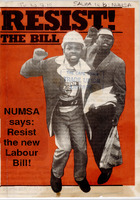
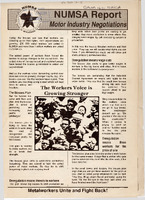 Today the bosses can see that workers are standing up for their rights. Their organisations are growing. 230 000 metal workers are united in NUMSA and more than 1 million workers are united in COSATU. The united power of workers have forced the bosses to accept changes to the vicious LRA. The united voice of the oppressed and exploited people have forced the bosses government to unban our organisations. And so the workers voice demanding control over their own lives is growing stronger day by day. The bosses can see that the workers have a plan. That workers are marching along a road which will lead them to victory and freedom. But the bosses too come with their own plan. And the bosses plan is aimed at protecting and increasing their profits and priviledges. The bosses plan is trying to force the workers to walk along the road of deregulation and increased profits for the bosses. This plan is seeking to divide workers and so to break their strength. The bosses plan aims to undermine centralised bargaining. They are scared to face the united power of motor workers. So they try to shift bargaining to plant and company level.
 -
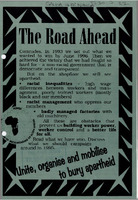 Comrades, in 1993 we set out what we wanted to win by June 1996. Then we achieved the victory that we had fought so hard for - a non-racial government that is democratic and transparent. But on the shopfloor we still see apartheid: racial inequalities - high wage differences between workers and management, poorly trained workers (mostly black and our members) racist management who oppress our members, badly managed factories with S old machinery. All these are obstacles that prevent us building worker power, worker control and a better life for all. Read what we have won. Discuss what we should campaign around in 1995.
 -
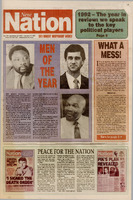 ANC general secretary Cyril Ramaphosa (top left), and constitutional affairs and communications minister, Roelf Meyer, (top right) have been chosen as joint winners of New Nation's 'Man of the Year Awardâ€. The New Nation Award for "Businessman of the Year†goes to National Sorghum Breweries (NSB) chairperson, Professor Mohale Mahanyele (right). This is the first time that both awards are being made. The awards will be given annually in future in recognition of individuals who are deemed to have made a contribution in providing leadership for the general uptiftment of the people of South Africa. Ramaphosa and Meyer have been chosen for their tireless efforts in holding the negotiations process together during very arduous and difficult times. The rapport the two have struck has made a crucial difference as to whether the negotiations process flounders or goes forward. The two leaders are young and are likely to provide continuity and the excellent leadership that the transition period requires. Prof Mahanyele has provided bold imaginative leadership in the business world. He has placed black economic empowerment firmly on the agenda and has set his own company as an example of this. New Nation believes that it is business leaders like Prof Mahanyele who will ensure that black people reclaim their rightful place in the economic life of the country. The awards will be officially presented to their winners early in 1993. Democratic Party (DP) leader, Dr Zach de Beer, said: “The two (Ramaphosa and Meyer) have given all they could to get the negotiations process back on track... they deserve it.†The newly-appointed chief of the Development Bank of South Africa Prof Wiseman Nkuhlu said Prof Manyelele's achievement would “serve as a model to other black organisations involved in economic empowermentâ€.