
General Materials
Item set
- Title
- General Materials
- Alternative Title
- LRS General Materials
- Creator
- Labour Research Service (LRS)
Items
-
 This document should be used by ail of us involved in Education as a basis for discussion on organising education in the Federation. We have pulled together all the relevant information and reccommen- dations which we hope will assist Led- comm, Educators and our constitutional structures in understanding what our tasks are in the locals and in affiliates. The Redcomm agreed that an Education Programme must go beyond being just a number of workshops and seminars. It must be a dynamic process which must contribute to the strengthening of our structures, improving the quality of our debates and promoting leadership of the working class in our struggle for democracy.
 -
 THE South African Commercial Catering and Allied Workers Union (Saccawu) launched a medical aid fund yesterday which the union said would be used as a springboard for the establishment of its own medical aid scheme. Saccawu assistant general secretary Herbet Mkhize said the fund would operate under Medscheme's Meddent Medical Scheme for about nine months while the union conducted further research into establishing its own medical aid scheme. Mkhize said trade unions were no longer only competing with one another but also with legal firms that were now offering their services to workers. “Now a trade union has to convince potential members that it offers the best services, “Mkhize said.
 -
 Since 1989 most workers in South Africa have had their wages taxed under the Site Tax system. SITE stands for Standard Income Tax on Employees. Under the Site Tax system, the employer is responsible for making sure that workers pay the correct, amount of tax. This is different from the old Pay As You Earn (PAYE) system where the Receiver of Revenue had to make sure that the amount of tax paid was correct. Now the employer works out how much tax has to be paid from the personal information, such as number of children, given to them by each worker. But COSATU has seen that many workers have been taxed too much by their employers. This is mostly because no-one has explained to workers how the Site Tax system works and what tax reductions they are entitled to.
 -
 Getting and carrying out mandates is one of the most important duties of a shop steward. This booklet has been prepared to help shop stewards carry out this duty. In a democratic organisation the job of a representative is to represent other people's views and wishes - to carry out the mandate of the people who elected them. For the people to feel that this is happening they must be able to know what their representatives are doing and saying. They can only know this if they get report-backs from their representatives on what they have been doing. The representatives on their own cannot make decisions for the people. People must be able to discipline representatives who don't represent their views.
 -
 This workshop is designed to give you a reliable introduction the Employment Equity Act. It is based on hard information and on ACTIVITIES or discussion exercises that will help you to understand how the Act works, who it covers , and what the implications are for trade unionists. Each of the Activities is complemented with information that will help you to understand the Act in more detail. Sections have been added to help you find further information, and to understand the terms that are used in the Act itself. In a two day programme, you are not going to be an 'expert' on the Employment Equity Act, but we hope that you will feel more confident about using the Act, especially in ensuring that it is used to address a wide range of discriminatory practices at the workplace. As with most legislation, the more that you begin to use it, the more its strengths and weaknesses will emerge. It is very important that any weaknesses in the practical application of the Act are reported through your Union to the Federation. This will help the Federation to campaign for improvements in t he legislation, and to close any loopholes that allow employers to avoid their responsibilities.
 -
 COSATU must intervene in affiliates where it has identified problems, where problems have been brought to its attention and / or has been requested to do so. The CEC should draw guidelines on how and under which circumstances the federation and its structures may intervene taking into account clauses 3.9 and 3.10 of the constitution. Such intervention should not undermine affiliates where such problems exist. COSATU leadership must be visible during major disputes between affiliates and employers and co-ordinate solidarity with workers involved in such disputes.
 -
 The Liquor and Catering Trades Employees' Union have made big demands for higher wages and shorter working hours to the bosses of the hotels. This is because wages are far too low for hotel workers while working hours are very long. These demands will be discussed at the Industrial Council, where your union representatives will argue for big improvements in working conditions. But we can expect strong opposition from the bosses who have their own representatives on the Industrial Council. So the union campaign for higher wages will not be easy! But we must win it because workers and their families are suffering and the union campaign is our only hope. The fight will not be won at the Industrial Council, however - it will be won in the hotels. We have to build up the union's strength in each and every hotel so that the bosses see that we are determined to win our demands. This booklet will help you to build up the workers' organisation in your hotel. Use it to discuss the union campaign so that every worker knows what part he or she has to play.
 -
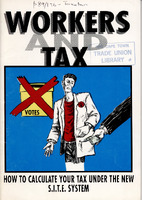 Through their organisations, workers have raised ill many problems with the tax system in South Africa. The main issue is that although everyone in South Africa pays tax, the majority of the people cannot choose their government and so they have no say in how their money is spent. Only 14% of South Africans can vote for the government. However, the government decides howto use everyones' money. Clearly, then, the payment of tax is a political issue. Everyone should have an equal say in how their money is spent. Tax is also an issue that particularly concerns workers. Since the introduction, in 1988, of the Standard Income Tax on Employees (SITE), workers have had their tax assessed by their employers. How this happens and the problems that this can cause, are set out in this booklet. Many workers may have paid too much tax between March and July this year. They should be refunded the money. It is important to check and see if this has happened. The booklet will explain howtodo this and will teach people how to work out how much tax they should be paying. Tax is also being taken up as a womens' issue because married women pay more tax than anyone else.
 -
 COSATU has adopted the Freedom Charter. But if we look carefully at the Freedom Charter, nowhere does it say how everyone will share in the country's wealth. This Is because a Chartrr is a statement of beliefs and a guide to policy. It is not a detailed programme.
 -
 Impelasonto kaNovember 29 kuya kuDecember 1 yabona ukuphakanyiswa kwefederation yezinyunyana zabasebenzi bezimboni enkulu kunazo zonke emlandweni wabasebenzi baseSouth Africa. ICongress of South African Trade Unions inamalunga akhokha kahle awu-449679 kuzo zonke izimboni ezisemqoka kulelizwe ngaphandle kwemboni yezolimo. Kodwa kulesikhashana esizayo izogqugquzelwa nemboni yezolimo, njengoba uCOSATU athatha isinqumo ekugcotshweni kweCongress sokwelekelela ngezimali ekuququzeleni izimboni zezolimo lezikahulumeni.
 -
-
 COSATU must intervene in affiliates where it has identified problems, where problems have been brought to its attention and / or has been requested to do so. The CEC should draw guidelines on how and under which circumstances the federation and its structures may intervene taking into account clauses 3.9 and 3.10 of the constitution. Such intervention should not undermine affiliates where such problems exist. COSATU leadership must be visible during major disputes between affiliates and employers and co-ordinate solidarity with workers involved in such disputes.
 -
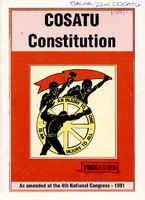 We the Trade Union representatives here present firmly commit ourselves to a unified democratic South Africa, free of oppression and economic exploitation. We believe that this could only be achieved under the leadership of a united working class. Our history has taught us that to achieve this goal we will have to carry out the following tasks : Organise the unorganised and build effective trade unions based on the democratic organisation of workers in the factories, mines, shops, farms and other workplaces. Organise national industrial trade unions, financed and controlled by their worker members through democratically committees. Unify these industrial unions into a national worker controlled federation. Combat the divisions amongst the workers of South Africa and unite them into a strong and confident working class. Encourage democratic worker organisation and leadership in all spheres of our society together with other progressive sectors of the community. Reinforce and encourage progressive international worker contact and solidarity so as to assist one another in our struggle. We call on all those who identify with this commitment to join us and the workers whom we represent, as comrades in the struggle ahead. We call on all trade unions to strive to unite their members in their ranks without discrimination and prejudice, and therefore resolve that this federation shall determinedly seek to further and protect the interests of all workers and that its guiding motto shall be the universal slogan of working class solidarity: "An injury to one is an injury to all".
 -
 Eskom started the 1989 wage negotiations with an offer of 7% on average. They said this offer is ail they need to make to keep their relative position in the labour market. we believe that the Eskom offer is contrary to the substance and spirit of Arbitration Award which forced Eskom, in 1988, to grant a 14,8% average increase in place of the 10% average increase Eskom implemented unilaterally m July last year. Dr Dry, the Eskom personnel manager, read out from an NUM pamphlet issued after the arbitrators raised the wages. He read out this one sentence. Today, through unity, the minimum wage rates as Eskom are amongst the highest in the country for workers living in compounds.
 -
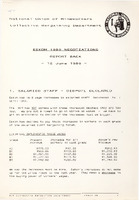
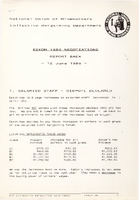 Eskom has paid wage increases to salaried staff backdated to 1 April 1989. The NUM has NOT agreed with these increases because they are too low. We are not allowed to go on strike at Eskom - we have to get an arbitrator to decide if the increases must be bigger.
 -
 COSATU must intervene in affiliates where it has identified problems, where problems have been brought to its attention and / or has been requested to do so. The CEC should draw guidelines on how and under which circumstances the federation and its structures may intervene taking into account clauses 3.9 and 3.10 of the constitution. Such intervention should not undermine affiliates where such problems exist. COSATU leadership must be visible during major disputes between affiliates and employers and co-ordinate solidarity with workers involved in such disputes.
 -
-
-
 We are forced to acknowledge the major strides which SADTU has made as a union representing the interests of its members. But with equal sobriety and honesty, we have to take stock of the enormous challenges which lie ahead of a union, which is still relatively weak, both structurally and programmatically. Several branches have not been functioning effectively because of the inconsistency of leadership and grassroots members. The crisis of commitment is also reflected in the irregularity of union meetings at site and branch level and the crisis-related activities of SADTU. Because of our weakness in local structures, we are thus forced to respond in a knee-jerk manner to each specific crisis, without consolidating, the members(or non-members) in a union building process.
 -
 SADTU has planned to launch a major capacity building programme in 1996. SADTU is a young union. Formed in 1990 as the only non-racial, non-sexist and democratic teachers' union in South Africa, SADTU was viewed as a champion of teacher rights and thus the ideal organisation to campaign for transformative change. Consequently there was a significant shift of membership from established teacher associations. SADTU grasped this initiative and was able to earn an enviable position in educational struggles. The Union's tremendous growth in size however has meant more responsibility at all organisational levels. Teachers' demands and expectations have increased in the post apartheid era. Also the demands of educational reconstruction have become more complex. The country's constitution and the new political demarcations have necessitated a realignment of our structures. The creation of nine provincial education departments with concurrent powers with the National Ministry of Education has introduced still more challenges for the Union. SADTU is now faced with the task of co-ordinating its activities at five levels, namely: National, Provincial, Regional, Branch and Site.
 -
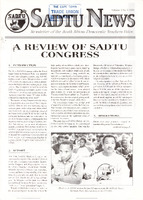 The Third SADTU Congress, held at the World Trade Centre in Kempton Park, was attended by over 800 delegates, representing 100 000 teachers country-wide. Delegates were elected at Branch level, ensuring grass roots participation in the highest decision making body of the Union. The Congress served to confirm SADTU's position as the largest teacher Union in the country, and demonstrated a strongly unified focus around the theme: “Unionise and Reconstruct for Teacher Empowermentâ€. The success of any Congress must be measured against the aims it sets itself. Our Congress had two aims: to elect new leadership for the next two years, and to adopt resolutions which would inform the direction and programmes of the Union in this period. While we successfully completed the former task, we could only make a start on the second aspect - confirming the fact that the period we are entering is far more complex than before, and in need of extensive analysis and debate. We therefore mandated the SADTU National Council to formalise the adoption of resolutions arising from the reports. A Special National Council was convened on 25/26 August, with extended participation by regions, and the Congress report can now be finalised.
 -
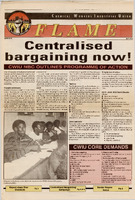 Keynote addresses were delivered by the Acting General Secretary, Cde Muzi Buthelezi, Cde Jay Naidoo COSATU General Secretary and CWIU President, Cde Don Gumede. Cde Gumede outlined the purposes of the conference “to assess progress and problems, to plan our path in order to provide a clear programme towards centralised bargaining as a result of proper analysisâ€, He urged delegates “to push employers into joint employers forums to negotiate on proper wages, job creation and an end to retrenchmentsâ€. Cde Jay Naidoo addressed the conference on the burning issues of the day. He spoke about VAT, the National Economic Negotiating Forum, trade union unity and CODESA. Cde Naidoo stressed that future economic and political policies must be formulated on the basis of daily and immediate issues facing the working people. Acting General Secretary, Cde Muzi Buthelezi outlined the progress made in the struggle for centralised bargaining. “We have to note†he said, “that the chemical bosses are very tough on this question. They do not want to negotiate, meet or do anything as an industry. They want to keep all activities at a plant or company levelâ€. The remainder of the conference was given the task of redefining the sectors within the chemical industry, developing core demands and outlining a programme of action. Delegates broke into their different sectors to discuss these issues before returning to plenary to thrash out the major steps to be taken by the union in the coming months.
 -
 There is acceptance within Cosatu that a Trade Union Education Institute should be urgently set up to assist in the building of Cosatu and affiliate capacity and skills in our new situation. It is recognised that there is a need for a more systematic.ongoing,professional education and development service winch such an Institute could provide. However, the form,status, control programme of this Institute is not yet agreed upon. Cosatu is in danger of losing control of this project,as other bodies set up and acquire funds to train trade unionists.
 -
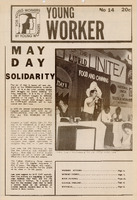 The 1st of May is known all over the world as the INTERNATIONAL LABOUR DAY. It is a day when workers pledge their struggle for better working and living conditions. It is a day of showing a link of workers struggle in different countries of the world. It is a symbol of taking forward their struggle against the CAPITALIST SYSTEM and to take control over their lives. In 1890 the Second International Workers Congress accepted MAY DAY as an INTERNATIONAL DAY OF SOLIDARITY FOR ALL THE WORKERS OF THE WORLD. Recently in South Africa, fight for May Day to be recognised as a paid public holiday is once more on the agenda of the worker movement. This demand comes at a time when workers have continued to build their trade unions. Thanks to the militant struggles of the early 70's which paved the way for the present strenght of the unions. Already many companies have signed agreements to recognise May Day as a paid holiday. Last year the 100 Annivesary of May Day was celebrated with militance and dignity. More than 1,5 million workers supported the call to attend the rallies which were held all over the country. The Labour Monitoring Group reported that it was the biggest stay-away in over 25 years. The biggest rally organised by COSATU at Orlando Stadium attend ed by close to 20 000 people. Last year support for MAY DAY symboli- shed that workers are beginning to decide what holidays they want and not the states idea of holidays. Its a symbol of hope for the working class that to build a society based on the principal of workers control, workers have to be incontrol of these actions.
 -
 COSATU must intervene in affiliates where it has identified problems, where problems have been brought to its attention and / or has been requested to do so. The CEC should draw guidelines on how and under which circumstances the federation and its structures may intervene taking into account clauses 3.9 and 3.10 of the constitution. Such intervention should not undermine affiliates where such problems exist. COSATU leadership must be visible during major disputes between affiliates and employers and co-ordinate solidarity with workers involved in such disputes.