
General Materials
Item set
- Title
- General Materials
- Alternative Title
- LRS General Materials
- Creator
- Labour Research Service (LRS)
Items
-
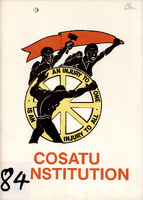 We the Trade Union representatives here present firmly commit ourselves to a unified democratic South Africa, free of oppression and economic exploitation. We believe that this can only be achieved under the leadership of a united working class. Our history has taught us that to achieve this goal we will have to carry out the following tasks: To organise the unorganised workers and build effective trade unions based on the democratic organisation of workers in the factories, mines, shops, farms and other workplaces. Organise national industrial trade unions, financed and controlled by their worker members through democratically elected committees.
 -
 The CWIU recognises the need to develop a long term organisational vision, develop and implement creative and effective strategies, prioritise campaigns/activities in order to be able to sustain these, adapt and change by a process of restructuring, deal effectively with political and economic issues. Development of a long term Vision Congress reaffirms our objective of a socialist future Our programmes must therefore reflect this vision. The trade union movement as a working class organisation has a major role in any socialist programme. The labour movement must remain independent. This independence must not be compromised. Overall strategy for trade union movement The current direction of Cosatu towards so called "Strategic Unionism" must be thoroughly discussed. A progamme of discussion on this must be implemented in the Union. We confirm our belief in the following principles and any strategy must be based on these: worker control, accountability of leadership a combination of negotiations,mass action and struggle as the means to achieve our goals/demands.
 -
 Since the late 1980's, there has been a serious realisation on the part of Cosatu and CWIU leadership, of the need for Centralised Bargaining. Two broad areas of concern which pressurised us in this direction were: 1) The low level of class consciousness on the part of the majority of members during this period especially with regard to the complete lack of solidarity around wage struggles. 2) The organisational incapacity of the unions to cope with the excessive demands of plant based bargaining. This wasted resources and undermined the quality of work and achievement of annual wage bargaining. Faced by this reality, achieving consensus on the need for a campaign to achieve centralised bargaining at leadership level was relatively easy. Unions in other sectors eg. metal, mining, clothing, textile and the public sector, regularly set examples of what could be achieved by well run centralised bargaining. Numsa's experience illustrated the strengths and pitfalls of centralised bargaining - ie. Numsa's mandating and report back processes, the Mercedes Benz strike by opponents to the "one bite at the cherry".
 -
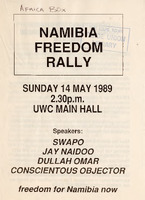 Die mense van Namibia het uiteindelik hul vryheid gekry! Hulle het getriomf teenoor die koloniale regering in Pretoria en die brutale apartheid magte. Die mense van Namibia sal binnekort hulle self kan begin regeer. Hulle sal 'n nuwe nasie bou - vry van onderdmkking en uitbuiting.
 -
 Machipanda, February 3,1995 (AIA/Brian Latham)—Many Zimbabwean peasants have quietly found the solution to land shortages by crossing into neighbouring Mozambique where it is plentiful. For as little as US$ 10 a field, they are acquiring land and a place to live — probably illegally — from chiefs and headmen across the border. Information on how to get land is easily accessible in Machipanda, the Mozambique border town at the head of the Beira Corridor from Zimbabwe to the Indian Ocean. Confusion reigns in Mozambique in the aftermath of the devastating civil war. And in a country reputed to be the poorest on earth, the government can do little to control the flood of border jumpers in both directions: Mozambicans enter Zimbabwe to sell everything from guns to clothes donated by aid agencies and Zimbabweans enter Mozambique in search of land to till.
 -
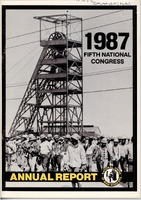 1986 was a tumultuous year as mineworkers waged gallant battles on many fronts. It was a year when mineworkers were continuously compelled to take militant action to advance not only their cause as mineworkers but to advance the liberation struggle. The State of Emergency brought about a level of dedication and commitment amongst mineworkers that had never been experienced before as several structures of the union had to function without their leaders for some time. The intransigence of bosses in wage negotiations propelled mineworkers to unprecedented levels of militancy and compelled many employers to capitulate in the end. 1986 saw mineworkers participating in many more strikes than other workers and their participation in nationwide stayaways was clear evidence that "THE MINERS HAVE ARRIVED."
 -
 Windhoek, January 16,1995 (AIA/Joshua Amupadhi) — Many impoverished Namibians are demanding swifter change to better their lives following elections which restored the ruling SWAPO party to power for another five years. SWAPO, the former guerrilla organisation which fought for the independence of Namibia from apartheid South African rulers, won an easy victory in the first post independence elections in December. Those interviewed say five years were enough for the former liberation movement to have made a good start on improving the standards of living of many previously disadvantaged Namibians and dismantle apartheid structures established during 75 years of South African colonialism. One SWAPO supporter says independence has created only a black elite to join whites in the rich suburban areas but has not narrowed the gap between the rich and poor.
 -
 The NUMSA Central Committee endorsed the National Bargaining Conference's deliberations held on the 15 - 17 March and mandated the union negotiators to make reductions of the apartheid wage gap the main thrust of the negotiation as part of an integrated package. We are proposing an integrated package of changes to all aspects of the industry to be negotiated in the process of negotiations.
 -
 Sowa, January 3, 1994 (AIA/Caitlin Davies) — Mercy Manakedi Theetso is 29 and has four children. She breast-fed her first child for 18 months, her second for eight months, and she didn't breast-feed her third child at all. “I was working and the baby stayed with my mother so we used a bottle for the first four months, then we used a cup,†explains Theetso. “Myself, I like to breast-feed but I don't have the time.†In the 1960s Botswana's medical practitioners began giving new-born babies the bottle. Now, 30 years later, there is a concerted effort by the Botswana government to promote a return to breast-feeding. But as women have gone out of the home to work, reversing the trend is not an easy task. However, breast-feeding does remain popular in Botswana. “It's a culturally acceptable norm,†says Virkloti Morewane of UNICEF, and boys and girls are fed for the same amount of time.
 -
 During the 1930's the world experienced the most wide-spread and severe economic depression in its history. The beginning of the Great Depression was signalled by the great crash on the New York Stock Exchange in 1929.
 -
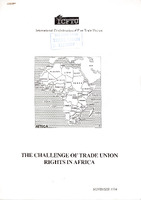 A purely academic observer would probably find significant cause for optimism about the evolution of the trade union rights situation in Africa in the 1990's, and about the observance of human rights more generally. The continent has lived under the sign of democratization since the beginning of the decade, and the extent of political transformation has been unprecedented and astonishing. Since 1989, at least 25 African nations have adopted entirely new constitutions or major constitutional reforms. To them may be added those countries - for so long an isolated minority - which already operated pluralist democratic systems and those, more numerous, which are still engaged in processes of transition and reform.
 -
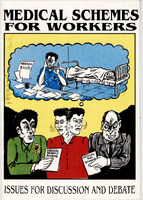 Medical insurance schemes have become one of 111 the many fringe benefits being negotiated by unions. Medical insurance schemes are tied to the struggle for an adequate health service. Workers' decision on whether or not to join medical insurance schemes has an important bearing on the operation of health services in a future democratic society. This booklet examines medical aid schemes, their advantages and disadvantages, how they operate and what possible alternatives to medical aid schemes exist. The booklet also looks at the state's health strategy and how medical aid schemes fit into this. Chapter One of this booklet discusses the broad issues relating to medical insurance. Medical Aid Schemes and Medical Benefit Schemes are discussed in chapters two and three. Chapters four and five are for extra information. Some specific medical aid schemes are evaluated in chapter four. Chapter five looks at the tariff structure (cost) of medical services provided at Natal Provincial Hospitals. Medical Insurance means all the different types of schemes that operate to insure people against medical costs. A medical insurance could take the form of a medical aid scheme, a medical benefit scheme or other types of schemes. This-booklet concentrates on medical aid and medical benefit schemes.
 -
 It would be desirable to establish a "platform" to market South Africa as an investment destination for foreign investors. The platform should not be limited to portfolio investors only, but should also include marketing to potential direct investors, lenders and development aid granters. The platform should relate to a "defined range" of potential investments. The group did not feel competent to define the range because it was not adequately representative. However the group did feel that the defined range should exclude the extreme left and the extreme right. By way of example the extreme right would be a short-term investment in a project in Botshabelo and an investment of the extreme left would be a non-income generating social upliftment project.
 -
 In the transition from apartheid to democracy, strong economic growth will be needed. This growth must succeed in overcoming the handicaps which apartheid imposed on South Africa. And it must bring higher living standards to the black majority, a reduction in absolute poverty levels, and a more equitable distribution of resources. The key to sustained and balanced economic growth is investment. Investment in productive capital must be greatly increased, and soon.
 -
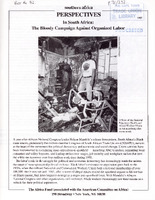 A year after African National Congress leader Nelson Mandela's release from prison, South Africa's Black trade unions, particularly the million-member Congress of South African Trade Unions (COSATU), remain at the heart of the movement for political democracy and economic and social change. Union activists have been instrumental in revitalizing mass opposition to apartheid — launching ANC branches, organizing local consumer and utility boycotts, and leading strikes over wages, job security and workplace racism that cost the white-run economy over four million work days during 1990. But labor's role in the struggle for political and economic democracy has increasingly made the unions the target of state-sponsored political violence. Black labor's resistance to oppression goes back to the 1920s, when the militant Industrial and Commercial Workers Union built a national membership of over 100,000. But it was not until 1981, after a wave of illegal strikes forced the apartheid regime to lift the ban on Black unions, that labor began to emerge as a major anti-apartheid force. With Mandela's African National Congress and other organizations still outlawed, Black workers increasingly saw their unions as a vehicle for their political aspirations.
 -
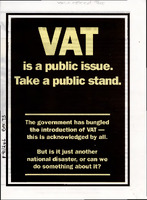 Although VAT is now part of daily life, it can be changed. Tax laws are changed all the time in the normal course of events. Public opinion and public action can change VAT. But the public must act. The government's record of disastrous financial management is costing us all — remember Mossgas? remember Inkathagate? It cannot go on. It is our democratic right and duty to press for changes that will make VAT serve the country. VAT enters every home in the country — it should be debated and managed as a public issue. We have already seen the value of action. There is overwhelming support for our demands to change VAT. That's why the government was forced to amend the VAT system twice in the few weeks before implementation.
 -
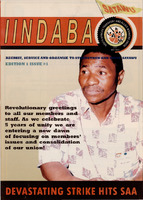 This year we are five years old. It is an important time in the history of our young merged union representing transport, cleaning and security workers under the revolutionary banner of federation COSATU, the liberation movement and the working class as a whole. On the 18 may 2000 we launched the new SATAWU comprising of members from the former SATAWU and former TGWU, bringing together public and private sector transport workers and cleaning and security workers. The battles that we have had to engage in, have been decisive and have contributed fundamentally to changing our society for the better. The bruising 1989 SARHWU strike stands out as one event that altered the labour relations in the public sector through the power and determination of organised transport workers. While the historic strike by our security members in kzn in 1993 also led to the first historic wage negotiations and the resultant sectoral determination in the industry setting a minimum floor of rights for all workers.
 -
 SANIBONANI NONKE FOSATU (X2) SIYANIBINGELELA NONKE NGO 1985 (X2) We greet you all FOSATU we greet you all in 1985 SIYANIBINGELELA NONKE NGO 1985 (X4) We greet you all in 1985.
 -
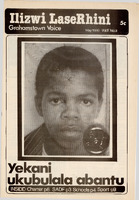 COSATU must intervene in affiliates where it has identified problems, where problems have been brought to its attention and / or has been requested to do so. The CEC should draw guidelines on how and under which circumstances the federation and its structures may intervene taking into account clauses 3.9 and 3.10 of the constitution. Such intervention should not undermine affiliates where such problems exist. COSATU leadership must be visible during major disputes between affiliates and employers and co-ordinate solidarity with workers involved in such disputes.
 -
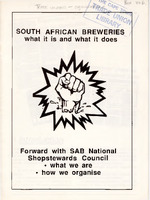 This booklet is to be used by unions organising in South African Breweries subsidiaries. The aim of this booklet is to provide an understanding of SAB which will help in working out how to negotiate with a monopoly of this size. As such, the booklet is divided into two sections. The first section looks at SAB, who owns it, how it is structured, how profitable it is, what it owns, etc. This section summarises the essential information about the company. We have drawn on a report by the Labour Research Service to assist in this section.
 -
-
 The decline in world energy consumption caused by the twin oil price hikes of 1973 and 1979 checked development in the major market economies and triggered the process of industrial restructuring that has so profoundly affected all sectors and all regions. ore efficient use of more expensive energy and strategic policy changes have made major contributions to easing the historical reliance upon energy inputs - especially in the case of oil. As a result the ratio between energy consumption and growth of gross world production has diminished by nearly 25 % over the past fifteen years. It has been estimated that full use of available energy-efficient technologies could cut per capita energy use by as much as 50% without impeding economic growth. The extent to which these gains are realized will depend upon a wide variety of economic and developmental factors, among which the price management of fuels is a very important one. here has also been a change in the industrial mix of the major OECD economies with the decline of old industries using high energy imputs and the rise of high technology sectors with different and lower energy requirements. The shift of much basic manufacturing to new locations in the developing world and to the hitherto centrally planned economies is likely to precipitate a further important change in energy requirements. emand for energy is forecast to continue to grow at only about half the rate of general economic growth over the short to medium term. Consumption is very uneven on a world scale, however. In 1988 the world consumed energy equivalent to some 8 billion tonnes of oil (Tonnes Oil Equivalent, or TOE) - an average of 1.3 tonnes for every man, woman and child on Earth. While citizens of the USA will consume an average of 8 TOE per capita, however, the average for both Japan and Western Europe is around 3 TOE, while people in the Third World still rely on fuelwood and dried animal dung as important energy resources, consuming only a small fraction of a TOE each in many cases.
 -
-
 All married women earning over R150 per month or over R34 per week have PAYE deducted from their wages. PAYE is income tax which is paid by workers on the "pay as you earn" system. Married men, however, pay tax only when their wages are over R500 per month. Single women pay tax only when their wages are over R350 per month. As you can see from the tables which follow, the tax on married women can be quite high. For example, if a married woman earns R220 per month, she will have R9,45 per month deducted from her wages for PAYE. (See Table No. 4). Married women who have children pay the same tax as if they haul no children, too. And there is no reduction in tax if you are over 60 years old, as there is for men. There is nothing can be done about this discrimination against married women until the government changes the tax rules.
 -
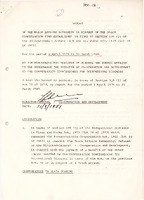 In terms of section 109 (1) of the Occupational Diseases in Mines and Works Act, 1973 (Act 78 of 1973) which repealed the Pneumoconiosis Compensation Act, 1962 (Act 64 of 1962) as amended, the Black Affairs Authority, defined as the Director-General : Co-operation and Development, is charged with the payment of a benefit or any other amount awarded by the Compensation Commissioner for Occupational Diseases in terms of the Act, or the previous Act, to or in respect of a Black person.