
General Materials
Item set
- Title
- General Materials
- Alternative Title
- LRS General Materials
- Creator
- Labour Research Service (LRS)
Items
-
 One of the most significant features of this year has been the employment of the four new people by CECS. Having so many new people in influential positions can be potentially dangerous for an organisation such as CECS which is rim along democratic lines. It thus becomes incumbent on the members of CECS to be vigilant against too much of the responsibility for the running of the organisation resting on the shoulders of the employed staff. Members should actively participate in decision-making so that it is they who determine the course of CECS. Each and every member should view themselves as an indespensible part of CECS, and that they share in the responsibility for the successes and failures of the organisation.
 -
 This edition of the CECS newsletter focuses on the democratisation of media through computers ("Computers For All"). It highlights a June 1989 camp at Wattle Park, Noordhoek, where high school students and teachers were trained in desktop publishing, photography, and scanning to create community media. Key topics include "Transformative Education," desktop publishing software reviews (Ventura, Publish It!, Newsmaster), and a feature on computer viruses ("Ghosts in the Machine").
 -
 COSATU must intervene in affiliates where it has identified problems, where problems have been brought to its attention and / or has been requested to do so. The CEC should draw guidelines on how and under which circumstances the federation and its structures may intervene taking into account clauses 3.9 and 3.10 of the constitution. Such intervention should not undermine affiliates where such problems exist. COSATU leadership must be visible during major disputes between affiliates and employers and co-ordinate solidarity with workers involved in such disputes.
 -
 This document is as adopted by the SAMWU NEC in November 1994. It serves to define the wages and conditions of employment applicable to all SAMWU staff and is the only conditions of employment document of the union. Employees who were staff of a pre-existing trade union which merged with SAMWU who have conditions which were previously declared personal to holder ( in terms of merger agreements ) are required to examine this document and to individually register where they, consider that their terms differ from this document. No improved condition hereby introduced can be taken to apply to such employees as a matter of right . They have a choice of registering specific conditions as †personal to holder " or converting to the full set of conditions as contained herein. Where they register a condition as personal to holder the NEC will decide whether new conditions hereby introduced are also applicable to them. It is further recorded that whilst these conditions of service are open to be ammended from time to time ; as-the NEC may decide , any representations for amendments shall normally only be considered during the later part*of-each year.
 -
-
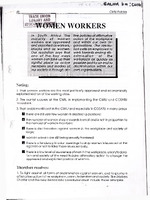 In South Africa the majority of women workers are oppressed and exploited as workers,blacks and as women. Our resolution says that one of the key ways women can take up their rightful place as active members and leaders of our society is through active policies of affirmative action at the workplace and within our own organisations. The resolution calls on employers to work towards ending discrimination at the workplace as quickly as possible and for an end to discrimination within our own organisations.
 -
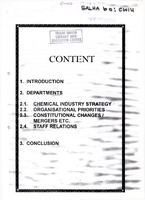 The idea to restructure the union is not a new one. Political changes in our country compelled almost all the unions to consider the possibilities of restructuring the union and the industry in general. New approaches to Collective Bargaining Strategies came to the fore. The good example of these Bargaining strategies was the NUMSA THREE YEAR BARGAINING STRATEGY (1993). Later in the same year, CWIU also introduced its Bargaining Strategy in the form of five pillars. The common thing about Numsa and CWIU bargaining strategies is that they both failed to deliver and the process of setting up working groups are more complex than expected. The main cause of the tap problem in my view is that the existing union structures are a big deterent to the development and implementation of new bargaining strategies. Our Centralised Bargaining victory and the new LRA will demand major union restructuring if we want to utilise the openings created by these new developments. In this discussion paper, I will focus on how we should restructure our union. In this paper, I am suggesting that the union (CWIU) must be made up of four semi-autonomous departments.
 -
 This Trade Union shall be a body corporate with perpetual succession capable of entering into contractual and other relations and of suing and being sued in its own name and shall be an organisation not for gain.
 -
 The COSATU leadership is asking all its affiliates to discuss a way forward for South African workers. The COSATU National Office Bearers have produced a document titled "COSATU 1993 Discussion Paper on a Way Forward". It deals with the "Reconstruction Accord". This Accord is a plan for organised labour during this period of transition in South Africa. Since this plan is laying the foundations for a future South Africa, the COSATU document is therefore a plan for the future of the working class. In this short paper we are going to answer the most important questions concerning this COSATU document: Is this the way forward for the workers? Is this plan going to free the workers from the chains of poverty and suffering? Is this plan going to lay the foundations for workers control of the economy, of politics and of the country? Is this plan going to stop retrenchments and starvation wages? In other words, we are going to study the COSATU leadership 's proposals from the point of view of the needs of the workers.
 -
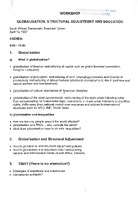 Globalisation of finance: restructuring of capital such as global financial speculation, mergers + closures). Globalisation of production: restructuring of work (changing processes and location of production), restructuring of labour markets (structural unemployment, rise in part-time and casual workers and homeworkers). Globalisation of culture: dominance of 'American lifestyles'. Globalisation of the state (government): restructuring of the state (state following rather than compensating for 'free-market logic', restrictions on trade union freedoms and political rights, shifts away from national control over resources and policies to international structures such as WTO, IMF, World Bank).
 -
-
-
-
 The achievement of international competitiveness within a 10 year time frame with: a minimisation of the loss of job opportunities in the textile industry, the growth and net creation of jobs in the clothing sector, both formal and informal, successful, in general, export-orientated textile and clothing industries, the acceptance by the industries of a greater responsibility for their own future by lessening their dependence on government by improving productivity through human resource development, work organisation and upgraded technology; a conscious move out of the lower end of the market but simultaneous efforts to retain these activities within the region; and a competitive environment where everyone gains, including the consumer, by making basic goods more affordable.
 -
-
 The launch of NEDLAC offers a unique opportunity to our country - a chance to rebuild the economy and society through a consensus forged among workers, investors, government and the community. The road to that consensus will, no doubt, be stormy and rocky. You cannot bring together Jabu Xulu, earning R200.00 per week, after working for 15 years, with a family of five to feed; and John Smith, the Chief Executive Officer of a major conglomerate, earning R20 000.00 per week, and expect that it will be a calm and easy process.
 -
 The aim of this discussion document is to begin a debate about the future role of COSATU. Its success will depend on concrete debate, discussion by membership and criticism of issues and/or direction. The analysis of the past three years will be addressed in a separate paper in preparation for the CEC and 5th National Congress] Since our inception, our guiding principle has been to bring about the transfer of power to the people. The present political settlement, no matter how flawed, takes us a step closer to that goal. All polls indicate that barring a miracle, the ANC will have around 60% representation in the next parliament and Government of National Unity and Reconstruction. This will indeed represent a break with the past and a real victory for workers and the country as a whole.
 -
-
-
 The first six months of 1989 has proved to be as busy as predicted, and the demand for mediation and arbitration services has increased steadily during this period. Year on year, whereas there were some 120 mediations and 75 arbitrations during the first six months of 1988, there were 195 mediations and 117 arbitrations during the first six months of 1989. This increase in demand may be attributed to a number of factors. In the first place, with the ever increasing unionisation of workers in South Africa a wider range of parties are resorting to third party intervention to resolve disputes. Secondly, labour and management who have had experience of mediation and arbitration, have continued to use third party neutrals to assist them in the process of dispute resolution. And thirdly, given the current political climate and the attitude of the major trade union federations to the recent amendments to the Labour Relations Act, it is apparent that parties are turning with greater frequency to independent third party neutrals to assist them resolve conflict. There are, for example, an increasing number of recognition agreements which require that conflicts of right be adjudicated through private arbitration under the auspices of IMSSA. Some German multinationals have, in accordance with the IG Metaal Code of Conduct for German investors in South Africa, agreed to refer disputes of right to private arbitration. IMSSA has for some time now been cited in the disputes procedures of many recognition agreements as the source of mediators.
 -
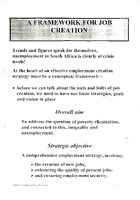 Trends and figures speak for themselves, unemployment in South Africa is clearly at crisis levels! At the heart of an effective employment creation strategy must be a conceptual framework - • before we can talk about the nuts and bolts of job creation, we need to have our basic strategies, goals and vision in place
 -
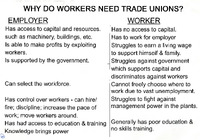
 This workshop is designed to give you a reliable introduction the Employment Equity Act. It is based on hard information and on ACTIVITIES or discussion exercises that will help you to understand how the Act works, who it covers, and what the implications are for trade unionists. Each of the Activities is complemented with information that will help you to understand the Act in more detail. Sections have been added to help you find further information, and to understand the terms that are used in the Act itself In a two day programme, you are not going to be an 'expert' on the Employment Equity Act, but we hope that you will feel more confident about using the Act, especially in ensuring that it is used to address a wide range of discriminatory practices at the workplace. As with most legislation, the more that you begin to use it, the more its strengths and weaknesses will emerge. It is very important that any weaknesses in the practical application of the Act are reported through your Union to the Federation. This will help the Federation to campaign for improvements in the legislation, and to close any loopholes that allow employers to avoid their responsibilities. All Labour Legislation, including the new Employment Equity Act should serve as a 'base-line' or minimum standard. Employer and Union observance of the minimum standards as laid down in law should be our starting point. Through collective bargaining and improved Union organisation, we aim to improve upon the standards set by the law, and increase the protection of our members. This is a real challenge. It is especially important for us all to recognise that as we enter into a period where employers are demanding more 'flexibility', the introduction of a new law to correct the legacy of imbalances left by apartheid at the workplace deserves our special attention. We hope this workshop is the first in a series of educational events that will cover this vital new area. The main aim of this workshop is to help you to understand the basic workings of the law, and how best it can be implemented. We also hope this programme encourages you to find out more about Employment Equity issues, and contribute positively to the struggle for the eradication of inequality. This pack is designed for a series of two-day introductory workshops that are being sponsored by COSATU in each region. A workshop of COSATU Educators held in September 1999 helped to assemble the material, and to test its appropriateness. As a result there are a considerable number of educators who can advise, and facilitate this workshop and who can be contacted via COSATU Education Department. We would also be very interested to hear how the pack has been used, and in particular how it can be improved to meet the needs of trade unionists who want to tackle discrimination using the tool of the Employment Equity Act, as well as other organisational means. If you use this pack, feedback would be most welcome.
 -
-
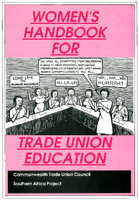 All over Africa today, and particularly in the Southern Region, women in trade unions are wanting to stand up and be counted. How do we get counted, is a question we ask ourselves? Education being the unanimous answer, we were all very happy when the CTUC decided to fund a Women's Handbook project with the blessing of the Southern African Trade Union Co-ordination Council. The project was implemented in July 1986 in Harare, Zimbabwe. Sisters from Botswana, Lesotho, Swaziland, Zambia and Zimbabwe got together and our initial objectives were:- • To identify problems faced by working women in the region. • To come up with solutions to these problems. Once the main topics had been defined - i.e. women in society, in trade unions and the law, bargaining issues, health care and education for women - we set about drafting material which was to be used for pilot courses with women workers in each country. Now, nearly a year later, after having met again in Mbabane, Swaziland in March/April 1987, we have our handbook. We want this book to be used to help women educators run courses for the rank and file women workers. Here it should be noted that as women who feel we have always been discriminated against, we do not wish to carry this on by excluding our male counterparts. Therefore even though our book is aimed at women, we would welcome assistance from our brothers! Finally, we hope that this book will be instrumental in bringing about an end to our struggle for women in the labour movement.
 -
 During the financial presentation of the company, the impression was created that the attributable income is unrealistic due to the fact that capital expenditure for the first six months were way below budget.