
General Materials
Item set
- Title
- General Materials
- Alternative Title
- LRS General Materials
- Creator
- Labour Research Service (LRS)
Items
-
 Comrades National Office Bearers of SACCAWU, other leadership of the Union at various level, the Wits Regional leadership of SACCAWU, the Shoprite Checkers NSSC NOBs, Officials, esteemed guests and delegates to this Summit, a substructure to the NSSC, I bring you warm and revolutionary greetings on behalf of the Shoprite Checkers NOBs and the entire NSSC and the entire SACCAWU membership. We are indeed honoured that you have all, particularly the SACCAWU NOBs, Officials and Guests, went to great length and sacrifices to ensure that you form part of this historic Summit. It is historic in that it is the only meeting of national competence convened in the year the NSSC turns twenty. Lest we forget, the Shoprite Council was launched in 1987, and has over the years relaunched to match the developments that were taking place within the company as it was growing its brands. Without your presence, we have no doubt that our debates would be poorer, leading to decisions that might in the long run prove inappropriate. You are once more welcome and assured that you are free to participate in the deliberations over the next few days. The Council have seen various onslaughts through the years and survived the iron-fisted resolve of the brutal apartheid regime and the capitalist system in its changing forms. It is the experiences of the time that has moulded numerous Shopstewards to an extent of understanding the necessity of participating within the Union and Federation structures. It is no coincidence that today, this Council has many of its Shopstewards in the CEC of the Union. It is of course worthless to have numbers in such structures if we do not play a positive and constructive role in shaping the direction of the Union. We can only do so if we are really grounded on the traditions of the mass democratic movement and the national democratic revolution. The Summit is convened after various components of the Alliance convened their own important gatherings. The deliberations in all such gatherings clearly points to the fact that our revolution is threatened by new tendencies ranging from internal squabbles and political intolerance of each other's views. The fact that our ANC is now a contested terrain should not surprise us as this was to be expected once we took over political power. What is surprising though is the apparent manipulation of some of our comrades by some forces intent on discrediting the Movement and the Alliance. Such state of affairs place a challenge to the working class, particularly organized labour to fight in defense of the revolution.
 -
 Comrades National Office Bearers of SACCAWU, leadership of the Company Council, distinguished guests & delegates to this Summit, we extend to you revolutionary greetings from the National Office Bearers of Shoprite Checkers, and the masses of Shoprite Checkers workers who are SACCAWU members. This gathering takes place exactly a year after our national strike. It also takes place after lot of significant gatherings of all the Alliance Partners i.e. COSATU Central Committee, SACP National Conference, ANC National Policy Conference, and on the home front, the SACCAWU National Bargaining Conference. It is the important that the deliberations in this gathering should look at all decisions taken during this significant event, the Bargaining Conference, and put them into practicality. This Secretariat Report will cover the activities since the National Shopstewards Council of June 2006 in Durban.
 -
 Comrades, this historical 3rd National Summit is convened at a time when the National Democratic Revolution is under attack left, right and centre. We have recently held an ANC Policy Conference; SACP National Congress and COSATU Central Committee, as well as SACCAWU National Bargaining Conference. These Alliance meetings took a number of resolutions for implementation. One has observed a very sorry state of affairs in that some shopstewards who are seen to be very prominent in Shoprite meetings, do not attend SACCAWU structures, let alone COSATU, ANC & SACP structures. This Summit will have to discuss on how we are to revive structures at Shoprite and participation in the aforementioned structures. For the record, it will prudent for one to bring to the notice of the Summit that to date, we have concluded a hand-over of which I will elaborate under NFC in this Report.
 -
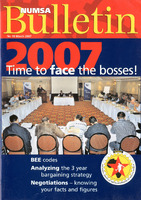 Numsa's National Bargaining Conference is almost upon us. Wage negotiations in all Numsa's sectors will start from May. Bargaining is the focus of this Bulletin (pages 12-28). We give you some basic facts and figures to arm yourselves for centralised bargaining. We also include information on the new black economic empowerment (BEE) codes as well as employee share ownership schemes (esops). You will need this information to negotiate in your own companies. Division rocked the Cosatu congress last year. Woody Aroun summarises a paper of Joel Netshitenzhe on the issue of factions within organisations while Alex Mashilo gives his own views on how to deal with them. Cosatu's recent Central Executive Committee analysed the current political conjuncture. See if you agree with it and prepare yourself for the challenges that face you in a year in which both the SACP and the ANC will be holding key conferences. What do you think of Desai's challenges to Cosatu? Are you up to them? Take yourself through Enver Motala's piece on education. Did your schooling give you these critical skills? Are your children getting these skills from their schools? Are Numsa's education courses helping you to grasp those skills that you didn't get at school? And what about education and training at work - are these filling the gaps in your education?
 -
 An annual Numsa Bulletin seems to be becoming the norm! However our aim is still to bring them out more often. Cosatu Congress is the focus for this Bulletin (pages 17- 39). We assume that you have Cosatu's resolutions and secretariat report so you will not find them here. We have instead included other background documents and articles that we think will help comrades debate resolutions in the September Congress. read the different understandings of the NDR by the alliance partners (page 18) how should we judge the actions of a developmental state (page 20) how Cosatu's jobs and poverty campaign can learn from Spain (page 23) understand what the Financial Sector Charter is all about (page 26) But there is much more to read - read the contributions from readers (pages 8-15), decide which brand of feminism you support (page 48) and do the test to see how gender sensitive you are. Learn tips from Aubrey ka Saki on how to avoid the VW- type situation (page 51) and absorb the findings of BEE research into Numsa-organised companies (page 55). How does your company compare? Do you have Esops in your company? Should Numsa adopt Esops as a way of going the BBBEE route or is it too risky? Study how the Merseta plans to complement Jipsa and how Bolivia is nationalising its hydrocarbons sector (despite a few hiccoughs!) Look at the glossary for definitions of those long words that always pop up at congresses and add words that are troubling you to it.
 -
 It is a year since the last Numsa Bulletin was published in September 2004. Last year Numsa's educators forum discussed how we could use the Numsa Bulletin more effectively. Included in this Bulletin are a number of topical issues that challenge you to debate issues at your local shop steward councils or your workplaces: If you are violently opposed to GEAR, have your views challenged by Motlanthe (page 14), Get your local to analyse what was agreed in the Alliance Summit earlier this year and give your score on whether you think the Alliance has met its targets (pages 22-23). Debate differences between the ANC's NGC document on two economies and Cosatu's response (pages 24-27). If you are an engineering shop steward in Middelburg, Witbank, Vanderbijlpark, Richards Bay, Pietermaritzburg, Vereeniging, then force a debate on the slow integration of House Agreements into the Main Agreement (pages 40-41). If you are an auto shop steward, then read Dumisa Ntuli's ideas (pages 42-44) on the shortcomings with black economic empowerment initiatives in the auto industry and debate the issues in your local/workplace. When was the last time you briefed members in your workplace? Do the organisational test on page 49 and see if you are up to the job. If you fail, redeem yourself by reading the health and safety, training and education sections and then debating and discussing the contents with your fellow members.
 -
 We hear a lot about the budget as an important expression of government policy. But what is the budget, what does it tell us about government programmes, and how can we influence it? This booklet aims: To support broader understanding and debate on budgets and fiscal policy as the basis for improving the public's ability to hold government accountable; To explain debates on and key concepts in fiscal policy, budget reform and government expenditure on major programmes; and In that context, to explain the proposals in the People's Budget and how the People's Budget Campaign works. The People's Budget Campaign is supported by a coalition of COSATU, the South African Council of Churches (SACC) and the South African NGO Coalition (SANGOCO). The People's Budget Campaign seeks to help people understand the budget better. Based on broad discussions and hearings, it works to develop proposals to improve government spending programmes.
 -
 We acknowledge Karen Hurt for the material development of the Report Writing section, Martin Jansen of the Labour Research for his contribution on the Wage Policy in Relation to the Macro economy, Saccawu's contribution on the Parental Rights and the Solidarity Center for HIV/AIDS. Thanks to all those who participated in the 2001 programme, without whom the redevelopment of this Block would not have been possible. These notes are developed to provide a support to facilitators when preparing to facilitate this course. They are not prescriptive! Please use them in a spirit of sharing ideas with other facilitators of this course and if you have insights and reflections from your facilitation experience, please let us have your comments to add to these notes!
 -
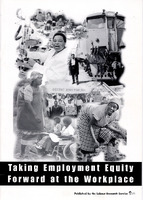 In 1998 the South African Parliament passed the Employment Equity Act. This law seeks to help establish equity in the workplace. It prohibits unfair discrimination in employment and requires employers to practice affirmative action. Employers who are designated by the Act must promote the employment of blacks, women, and disabled people in order to correct the discrimination of apartheid employment practices. The idea of producing an education booklet on Taking Employment Equity Forward at the Workplace came out of a series of workshops that were run in Gauteng, Kwazulu-Natal, and the Western Cape in September and October 2000. The workshop programme was designed by the Labour Research Service and run together with Khanya College and the Workers' College (Kwazulu-Natal). Affiliates of the trade union federations COSATU, NACTU, and FEDUSA were represented at the workshops, as were some unaffiliated trade unions. Of the 70 participants, 80% were shop-stewards and 26% were women. The main task of the workshops was to help participants gain some understanding of the Employment Equity Act so that they could help their trade unions to develop policies and practices around this legislation. This also meant that the workshops needed to explore workers' experiences of discrimination in the workplace and the broader legacy of inequality left by apartheid capitalism. Experiences of affirmative action practices in other countries were also discussed in the workshops.
 -
-
-
 Over the past few months, the Namibian labour movement - particularly the country's largest trade union federation, the National Union of Namibian Workers (NUNW) - has been the subject of debate and media attention. Contradictory statements by union leaders, the NUNW's position on the elections in Zimbabwe and the federation's role in the privatisation of Air Namibia have raised serious questions about the vision and mission of Namibian trade unions. This article hopes to shed some light on recent developments against the background of the ongoing challenges facing the labour movement since independence.
 -
 This report focuses on COSATU's organisation in the 21st century in terms of organising and service strategies; organisational structures; and leadership, management and staff development. In each section, the proposals point to key directions for organisational renewal. The report will be discussed at the Central Committee meeting on November 19 to 22, 2001. It should be subjected to detailed debate and mandating in the run up to the Central Committee. The Seventh National Congress established the need for this organisational review. It noted the “need for a thorough organisational review,†in order to avoid a piecemeal and ad hoc approach. It therefore resolved, “A commission be established: to review structures of the Federation at all levels, including the substructures of the CEC, to propose policy changes and where appropriate propose constitutional amendments. The commission must report to the Central Committee in 2001, which will refer any proposed constitutional amendments to the next Congress.†In February 2001, the CEC established the Organisational Review Commission. At the time, it noted worrying trends in some unions' ability to maintain services to members, and therefore decided to extend the review to include all aspects of organisational development. In April, the CEC approved terms of reference. The members of the Commission are listed in Appendix 1. They include NOBs of COSATU and affiliates, regional office bearers, some COSATU heads of department, representatives of NALEDI and DITSELA, and an (expert on organisational review. In preparing this report, the Commission held several workshops, and the extended September CEC discussed the draft in depth. Still, the Commission's work was constrained by the lack of time and resources. Members have many other responsibilities, including mobilising for the strike against privatisation in August. The Commission itself did not have a dedicated budget.
 -
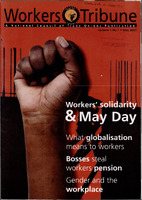 Nactu, the second largest trade union federation with a membership of more than 500 000 workers from across various sectors, publishes this month its new baby. Workers Tribune, a monthly magazine that will communicate the federation's message to its members and other interested parties. It was not by accident that the birth of this important publication should coincide with May Day. For Nactu, May Day is the embodiment of workers' and peoples' struggles that has culminated in the freedom that South Africa enjoys today. We also know that these struggles occurred in an unfriendly, and often hostile environment, with many of the liberation heroes and heroines laying down their lives for the love of freedom and justice. We now enjoy democracy and freedom, and we must work hard at preserving it. We must always be mindful that it is easy to abuse freedom, and so we must strenuously be on the lookout for tendencies that seek to undermine freedom. We may have a new political order in our country, but there can be no question that the working class is still facing new challenges against capital, even black bosses. We still live in an environment that creates tensions between the working class and the bosses. We still have thousands of our comrades who have been retrenched because of the desire by bosses to realise big profits. And so, the struggle for workers' complete emancipation from tyranny is far from over. All bosses, including some we shared pain and abuse in the apartheid trenches, are capable of reverting to old ways. We must not forget that, like the erstwhile bosses of the apartheid era, they operate within an environment that is determined from outside,, and so they have to play the game according to pre-determined rules. The emergence of turncoats is on the increase. And for reasons I have alluded to, that should not surprise us. The trade union movement should increasingly prepare itself for other battles. But we should also empower ourselves with knowledge, so that when we dialogue with the bosses we raise compelling arguments. Slogans qlone do not work. We need to develop intellect as well. And so in this issue, Comrade Cunningham Ngcukana begins the process of teaching, and mental empowerment. He helps his readers to have a better understanding of what globalisation is all about, explaining that it is more profitable for unions to have profound appreciation of the workings of this system if they have to use it to their advantage. Ngcukana also writes about May Day. He tells us about the origins of this day. It is history we need because it is both informative and inspiring. A fine and commendable work by the general secretary of Nactu. There is also an article on gender equality in the workplace. Brenda Modise wrote it for us, and do read and enjoy it. To break the heaviness of the magazine, we also run a variety of pictures that seek to introduce to readers some of Nactu's leaders. We believe that it is important that you know your leaders in the trade union movement. Most importantly, however, we want to create a dialogue between ourselves and readers. Do, therefore, send us letters, commenting on various issues raised in this number. We hope to be of service to you. Do have a nice read.
 -
-
-
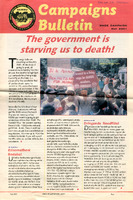
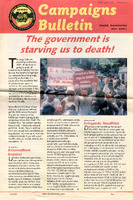 The wage talks are resuming on May 8th 2001. At the time of going to print, all provinces were holding marches all over the country to highlight our demands for a living wage. Currently on the table is a proposal by the conciliator that all parties should agree to accept an 8% across the board increase, and an increase in the minimum wage to R1900. Firstly this proposal has not yet been accepted by the employer. At the conciliation, the employer stuck to 5% only. Secondly this falls short of our demand. It means we will not get the R300 across the board. Any worker earning below R3800 per month is going to get an increase of less than R300. The hardest hit will be workers earning from R1700 - R3000 who will only get R136 - R240. There is nothing more we can get from conciliation or negotiations. It is now up to YOU the workers to decide if you will accept the 8% offer put on the table by the conciliator!
 -
 The wage talks are resuming on May 8th 2001. At the time of going to print, all provinces were holding marches all over the country to highlight our demands for a living wage. Currently on the table is a proposal by the conciliator that all parties should agree to accept an 8% across the board increase, and an increase in the minimum wage to R1900. Firstly this proposal has not yet been accepted by the employer. At the conciliation, the employer stuck to 5% only. Secondly this falls short of our demand. It means we will not get the R300 across the board. Any worker earning below R3800 per month is going to get an increase of less than R300. The hardest hit will be workers earning from R1700 - R3000 who will only get R136 - R240. There is nothing more we can get from conciliation or negotiations. It is now up to YOU the workers to decide if you will accept the 8% offer put on the table by the conciliator!
 -
-
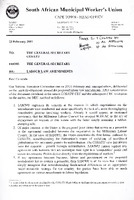 Our National Executive Committee met on 20/21 February and, amongst others, deliberated on the latest developments around the proposed labour law amendments. After consideration of the document circulated at the recent COSATU CEC and the subsequent CEC resolution on the matter, our NEC resolved as follows: SAMWU expresses its concern at the manner in which negotiations on the amendments were conducted and more specifically the lack of a more thoroughgoing consultative process involving workers. Already it would appear, as cautioned previously, that the Millenium Labour Council has usurped NEDLAC as the site of engagement on matters of this nature with the latter simply assuming a rubber- stamping role. Of major concern to the Union is the proposed joint vision that serves as a preamble to the agreement concluded between the negotiators in the Millenium Labour Council. In the view of SAMWU, the vision constitutes the first formal embrace by COSATU, notwithstanding the Federation's vision of socialism, of neo-liberal globalisation viz. economic growth for redistribution. The COSATU view has always been the opposite - growth through redistribution. SAMWU cannot support any agreement with business that acknowledges their right to a 'competitive' profit and secure investments. Profits derive directly from the exploitation of workers. If any agreement between business, labour and government on the proposed amendments has to contain a preamble, then SAMWU is of the view that it should simply recognise that notwithstanding fundamental differences on an appropriate macro-economic strategy for the country, the parties have been able to reach agreement on various amendments to labour legislation.
 -
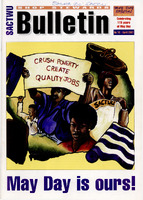 Cosatu has decided that May Day 2001 should focus on our campaign for jobs, and highlight the International Labour Organisation (ILO's) Declaration on Fundamental Principles and Rights at Work and its Follow-up. This is an important document. Adopted by the ILO's International Labour Conference on 18 June 1998, it arose out of "...concerns in the international community over the processes of globalisation and the social consequences of trade liberalisation...." The Declaration commits member countries to respect the following four core categories of fundamental rights at work, to promote it and to work for it to be universally achieved: • Freedom of association and the effective recognition of the right to collective bargaining; • The elimination of all forms of forced or compulsory labour; • The effective abolition of child labour; • The elimination of discrimination in respect of employment and occupation. The Declaration, importantly, emphasises that all member countries have an obligation to respect these fundamental principles, irrespective of whether they have or have not ratified the relevant ILO Conventions. As part of this special May Day edition of the Sactwu Shop Stewards' Bulletin, we reproduce the entire Declaration and its Follow-up. Discuss, debate and report back!
 -
 Ferro-metals (or Ferro-alloys) are used in making steel, to add different characteristics to the steel. The ferro-metals are often in the form of rocks. The ferro-metals are produced by heating the ore of the needed additive with iron ore. This ferro-metal is then taken to a steel works, where it is used in the furnaces.
 -
 In 1985, the Central Statistical Services and the Chamber of Mines ceased publishing a racial breakdown of mining industry employment. This marked the end of a statistical series that dated back for almost 100 years. Since 1985, there is no official series of racially segmented data for the mining industry, while the racial breakdown of employment in all other sectors of the economy was published up until 1992. From 1993, the Central Statistical Services introduced a new “Unspecified Race†category into its published employment data, making the identification of trends in employment and income by race less certain. The statistical information on racial issues in this submission must reflect these difficulties with the data. In respect of gold and coal mines that are members of the Chamber of Mines, the Chamber periodically has made available unpublished information on employment and total wages after 1985, grouped into “skilled employees†and “unskilled / semi-skilled employees.†Until about 1989, when legal barriers to the employment of blacks in skilled jobs were removed, the two Chamber categories reflect the old “White†and “Non-White†categories used by the Chamber before 1986. Since 1989, a small, but slowly increasing number, of skilled workers have been black, but this has not been taken into account in any of the statistics presented for the gold and the coal sectors. “Black†employment in the gold and coal mining industry thus refers to employees in Categories 1 to 8, the only groups for which the NUM currently bargains with Chamber member mines.
 -
 In June 1990, the United Democratic Front [UDF] appointed Brian Cumin, National Director of Lawyers for Human Rights as Commissioner to investigate and report on the reasons for the violence in Oukasie Township, Brits, since February 1986. Brian Cumin was empowered to appoint additional Commissioners to assist him. David Bam and Mpho Molefe, both practising Attorneys in Pretoria were duly appointed as co-commissioners. As part of their report on the reasons for the violence in Oukasie, the Commissioners have taken the liberty of making recommendations to the United Democratic Front.
 -
 In this booklet, the Labour Rights for Women (LRW) campaign looks at Childcare in the Workplace in South Africa. Nearly all working parents face the challenge of finding safe, appropriate childcare for their children while they work. In the past, women were traditionally seen as the primary carers of their children, with their work and careers coming second to their roles as mothers. But as the face of the workplace changes, many more women are in fulltime employment. Many more women also work in the informal sector. And many more women are developing their own career paths. In South Africa especially, many more women are also becoming the primary wage earners in their families, and many are also single parents. This means that changes in childcare policy and practice in the workplace are necessary. If parents, especially women, are to be productive members of the workforce whose contribution is taken seriously, they need a functioning system of childcare in the workplace to support them.