
General Materials
Item set
- Title
- General Materials
- Alternative Title
- LRS General Materials
- Creator
- Labour Research Service (LRS)
Items
-
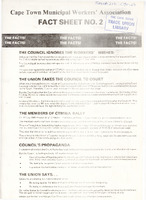 Members have shown tremendous interest in the Industrial Court Hearing relating to the Wage Dispute with the City Council. In addition to personal enquiries, we have received hundreds of telephone calls asking for progress reports. The calls are still coming in. It is in response to this clamour for information, as well as the Union's commitment to keep members informed, that it was decided to bring out this SPECIAL ISSUE of WORKER NEWS. We hope that members will now be better informed on the latest developments.
 -
 In every workplace there is a struggle. On the one side is the employer who seeks to make as much profit as possible, and on the other side are the workers who want a living wage and decent working conditions. For the employer's pockets to be full, the workers must suffer. For workers to get what they deserve, profits would fall. The interests of bosses and workers are different. This struggle is the spirit of capitalism. It fills the walls of every factory, the shaft of every mine, and the fields of every farm. But this struggle between bosses and workers is not like a soccer match between two equal teams. The employer has much more power than the worker : The employer owns the company. The employer has a big store of wealth from profit making to rest on. The employer has the power to hire and fire workers. The employer has the power to make decisions and give orders. The employer has easy access to lawyers, politicians and technical resources. Workers have one thing that bosses want. Their ability to work. But although employers need labour, this does not give an individual worker much bargaining power. Bosses and workers do not meet as equals in the market place, as many capitalist economists would like us to believe.
 -
 The Policy Unit of the Development Bank of Southern Africa (DBSA) has developed a number of strategic themes embracing many cross-cutting issues. The main thrust of the Unit's work, however, focuses on the core mandate of the Bank - infrastructure. In order to provide for a coherent whole, rural infrastructure must fit into a broader policy framework. Globally, the goals set for the first two decades of the next millennium are to address poverty and achieve food security. The DBSA can contribute to South Africa's position on these global themes by addressing the issue of rural infrastructure delivery, taking cognisance of the South African government's Growth, Employment and Redistribution (GEAR) programme. This discussion document will specifically address the local economic development activities of farm production and rural livelihoods in order to achieve food security, address poverty and foster economic growth in the marginalised, infrastructure-deprived rural areas of the country. It is assumed that additional entrepreneurial economic opportunities will arise at village and town level as producers become nett surplus producers, eg in small grain milling, cottage industry, village markets, processing (value adding), etc. In contrast to urban development, where economic activity is assumed by investing in infrastructure, the DBSA will actively have to support the transformation of economic activity in the rural scenario. One of the past successes of the DBSA has been the introduction of the Farmer Support Programme (FSP). The FSP's provision of services and support, based on the needs of existing smallholders, is embedded in participatory planning and action. Without local initiatives, rural infrastructure cannot be delivered effectively to bolster economic growth, create jobs and redistribute income. Most of the country's poor live in rural areas, and without rural development there can be no GEAR. Life in these areas needs to be made liveable by encouraging entrepreneurial development, which includes facilitating agriculture, creating jobs and increasing rural income through appropriate government actions for improving the welfare of rural households. One of the ways in which national, provincial and local government could have a broad-based impact is by providing rural economic infrastructure and, to this end, local government, including regional and district councils, has been mandated to develop integrated development plans. These plans have to include economic development plans, and entrepreneurial development has been singled out as important in this regard. From this it follows that district councils and municipalities have a prime responsibility for developing entrepreneurs, including farmers in their rural constituency.
 -
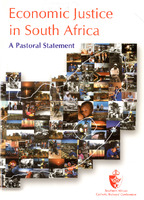 The Introduction to the statement explains that its aim is to contribute to the search for a more just, equitable and sustainable economic dispensation. It reminds people that, as a nation, we have overcome the horrors of apartheid and made significant progress towards peace and stability. However, we are sitting on an economic time-bomb; if we do not strive for economic justice we must expect a deepening of our social problems such as crime, lawlessness, poverty and unemployment. The second section considers the Church's Prophetic Duty to speak out and to bring Gospel values to bear on political, economic and social matters. A second transformation is needed: massive, and overwhelmingly positive, political change has occurred, but the same has not yet happened in the economy, with the result that the majority of our people still have little chance of fulfilling their reasonable hopes for a better life. Section three turns to the question of Discerning Economic Justice. It is asserted that every economy has a moral quality which makes it possible for us to pass judgements as to whether or not it is a just economy. In order to make such judgements the presence or absence of various factors must be assessed, including poverty, unemployment, discrimination, materialism and environmental degradation. Next, the statement deals briefly with Economic Structure. The fact that economies are complex, and that most people are unfamiliar with economic terminology, results in many people feeling powerless. They believe that, as individuals, they have no influence over, or responsibility for, the way an economy operates. Some of the negative consequences of such a belief are mentioned, and it is pointed out that we have a moral duty to make the correct choices, even in complex matters. Section four, Christian Economic Values, offers some guidelines for those striving to make these choices. The section summarises some of the main concepts and principles developed by the Church as ways of making concrete the commandment to 'love your neighbour as yourself'. These include the common good, solidarity, the option for the poor, the common destiny of goods, and the integrity of creation. The South African Economy is analysed in section six, according to the criteria mentioned in section three. Poverty, unemployment, materialism, greed, the lack of women's economic empowerment, debt and corruption are among the features identified as contributing to economic injustice in our country. But the gap between rich and poor is singled out as the defining characteristic of our economy, with millions of South Africans surviving, like Lazarus, on crumbs from the rich man's table. No country's economy exists in isolation, free from outside influences. Therefore, in section seven, some attention is given to The World Economy, especially to aspects which affect South Africa. The point is made that international factors can act as powerful constraints on moves towards economic justice at home, without their being, however, an excuse for a lack of effort in this direction. When statements such as the present one are published, people have a right to expect the authors to make specific and practical recommendations. This is attempted in section eight, What Can Be Done? The major role-players in the economy are identified and various steps are suggested for each of them; these range from fiscal initiatives to encourage job-creation, through changes to personal taxation and measures to improve productivity and training, to the promotion of the interests of the unemployed. However, it is conceded that even the most enlightened economic measures will not be able to withstand selfish and destructive attitudes. The question of people's attitudes to each other and to economic choices is therefore addressed, with particular emphasis being placed on the role of the religious community in this regard. By way of Conclusion the statement points out that economic justice is demanded not just by the poor and by forthcoming generations, but by God. In striving for a just economy we are carrying forward Jesus' great task of bringing fullness of life to all people.,2nd ed
 -
-
 Cosatu's Sixth National Congress held over four days from 1 6-1 9 September was on the surface a fairly well run operation in which Cosatu, with the involvement of the SACP, effectively drew the battle-lines with respect to its ANC alliance partner on the question of its Growth, Employment and Redistribution macro-economic policy - GEAR. The Congress also laid the groundwork in preparation for the ANC's upcoming December National Conference where socialists are expected to make a determined push in getting elected onto the ANC's National Executive Committee (NEC), as well as influence ANC strategy and tactics to counter the emergent Africanist grouping which threatens to dilute the ANC's working class bias. The Congress further saw Cosatu clearly attempt to reassert its socialist vision. Using its recently released September Commission Report as a basis for policy formulation, a decision was made that Cosatu should play an active part in the economy and the development of the country. This included Cosatu's involvement in areas such as industrial development strategy, changing investment patterns and new forms of management. The Congress, however, also witnessed the humiliating defeat of carefully crafted motions and much unfinished business concerning the finalisation of critical resolutions and debates raised from the floor. Cosatu's senior leaders including John Gomomo (President), Sam Shilowa (General Secretary) and Zwelinzima Vavi (Deputy General Secretary), were often caught wrong-footed by debates from the floor which countermanded positions thought out prior to the conference by the executive committee. The most embarrassing moment came for Cosatu's leadership when a recommendation to implement a gender quota was rejected by most affiliates, including women delegates themselves. Prior to the Congress, it had been recommended by the September Commission that the federation and its affiliates should adopt a quota system for women. A target had been set of 50 percent representation in all structures by the year 2 000. Mindful of the implications this held for the national affirmative action debate, Cosatu's leadership tried to side- track the issue for a later resolution but were rebuffed by the delegates. Similarly, the debate around globalisation took up a considerable amount of time, which led to Gomomo attempting to bring the debate to a speedy resolution. That in turn resulted in his censure from the floor. Earlier, Shilowa had embarrassed himself when he inadvertently seemed to state that he supported globalisation only to be reminded by the delegates that that was not Cosatu's position
 -
 As a democratic Union and driven by its members, it is imperative for us to bring about the transformation within the Cape Town Branch and the City Council. The Shopstewards, our elected representatives, cannot do it by themselves and therefore need the support and input from their members they represent. We need to: develope new leadership and build capacity within the organisation, seriously address workplace democracy and joint decision-making address gender equality at the workplace, develope the skills and competencies of workers, vigorously implement education, training and development programmes through Affirmative Action for those previously disadvantaged. WHAT IS YOUR ROLE ? We should also dissuade other SAMWU members from crossing over to other Unions for material benefits but that they look closely at the history of these Unions and whether they can adequately protect the rights of workers and whether they have the interest of workers at heart. We have seen how other Unions are recruiting members by offering them all kinds of elaborate schemes, but not addressing the fundamental issues of workers' rights, protection of job security, the right to strike and the question of narrowing the discriminate wage gap. We need to protect and fight against these policies of differentiation between workers. As we can see from the above, many challenges and work are lying ahead of us to build and unite the strong union. Now is the time - let us face the challenges together to build strong union and worker leadership.
 -
 My Government's commitment to create a people-centred society of liberty binds us to the pursuit of the goals of freedom from want, freedom from hunger, freedom from deprivation, freedom from ignorance, freedom from suppression and freedom from fear. These freedoms are fundamental to the guarantee of human dignity. They will therefore constitute part of the centrepiece of what this Government will seek to achieve, the focal point on which our attention will be continuously focused. The things we have said constitute the true meaning, the justification and the purpose of the Reconstruction and Development Programme, without which it would lose all legitimacy.
 -
-
-
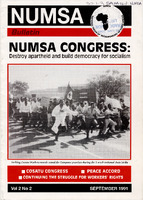 In this Bulletin we focus on the NUMSA and COSATU Congresses which were held in June and July this year. We also cover the National Peace Accord in some detail. In covering NUMSA's Third National Congress we focus on the major points discussed and contributions from guest speakers. We report on NUMSA's current membership and who the new Office Bearers are. We also produce in full the Resolutions that were adopted at the Congress. We report briefly on the discussions, debates and the resolutions that were finally passed at COSATU's Fourth National Congress. Unfortunately for reasons of space, we have not been able to print the resolutions adopted at this Congress. Shop stewards are therefore advised to contact their NUMSA Regional Office for a copy of the Minutes, Speeches and Resolutions of the Congress, or to contact COSATU Head Office which is due to produce a resolutions booklet soon. Much has been achieved in the negotiations around a Peace Accord between the ANC Alliance, Inkatha Freedom Party and the National Party. The Accord is pages long and is very detailed. We have tried in this Bulletin to give an overview of its basic features. We hope the chart that goes with the article will help people understand the detail and complexity of it and why it goes much, much further than all previous Accords. The Accord has now been signed by most of the major parties on September 14. Watch the press for details of a new Act which is due to be passed within 30 days outlawing
 -
 COSATU and UDF say, A climate for creating peace is slowly being established. But at the same time, a number of anti-peace forces are working to undermine our efforts. For years the police have been fanning the violence in Natal. In 1987 when peace talks with Inkatha were taking place they detained our leaders - thus sabotaging the peace talks. Throughout South Africa, the state has created and supported vigilante groups aimed at destroying progressive organisations. Now, after all the harm they have caused, they are trying to take credit for the peace that has recently been established in Tshongweni. In Mpumalanga, members of the Special Branch are attempting to hold peace talks with members of our organisations. We say that the police cannot be the agent of lasting peace. Peace will only come about when the organisations which are most affected come together and decide how peace can be enforced. The recent police shootings at Natal University, Cape Town, Pietermaritzburg and other areas remind us thgt the police are prepared to kill to save apartheid.
 -
 The idea of developing Research Groups in NUMSA was agreed to within the Education Programme for 1989. The areas of research emerged from the organising sectors of the union. This link between research, education and organisation was seen to be very important. The experiment has been very successful and could point the way to a successful research method for many other projects. The research groups have effectively combined academic researchers, service organisations and worker leaders. This has proved a powerful combination. The basic idea was that a small group of between 10-15 people from within NUMSA would work with outside researchers on certain key areas. The task of the group was to identify problems and a framework of proposals for how NUMSA could deal with the issues. These recommendations then went to the organisational structures for discussion and endorsement. Once endorsed it became the task of: organisational structures to carry out the implementation of the proposals through collective bargaining and campaigns. Education to educate and train people within the unions on these issues. Education would work with the research groups in doing this. the research groups to continue research if necessary. It is also our aim to link these research groups to study tours to other countries so that we can make comparisons.
 -
 During July and August this year, the united mass action of 25 OOO auto workers forced the bosses to negotiate nationally. Large demonstrations of workers demanding national negotiations marched and toyi-toyied through the plants. But auto workers also gave their bosses another strong message. United and strong, marching with large banners and replica AKs, workers were unbanning the ANC and flying high the red flag. Workers demanded the release of Nelson Mandela and all political prisoners. They said all hangings and political trials must stop. Workers demonstrated against the LRA and all other apartheid laws. Workers wanted their bosses to be clear. The bosses must know that the mass defiance campaign in the factory is part i of the struggle of the oppressed and exploited masses. When we are demanding better working conditions today, when we are unbanning our organisations through mass action today, we are demanding at one and the same time, control over every aspect of our lives in the factory and in the townships where we live. Our struggle for freedom is one struggle.
 -
-

-
 This survey was carried out in November 1973. My grateful thanks are due to the Grahamstown officials of the Cape Midlands Bantu Administration Board for permission to use the records of the Labour Office, and for the assistance given me during the survey. In particular I should like to thank the Area Manager, Mr. Bush, Mr. Freeman, the Manager, Mr. Hall, the Labour Officer, and the Clerks in the Labour Office who gave their help when needed. The aim of the survey was to provide up-to-date information on the basic rates being paid to African employees registered at the Labour Office in Grahamstown. The survey was intended to provide an overall view of wages paid in Grahamstown by various groups of employers, and to give some information on differing wage rates for males and females, and for Africans recruited in Grahamstown and working in other centres.
 -
-
 This was the first time I attended any Gender workshop or seminar. I can truly say that this was a real eyeopener to me. I would recommend this course or any other similar course to all women and not only to trade unionist , because we must empower ourselves.
 -
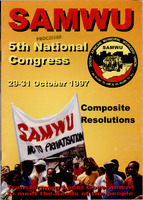 The implementation of our previous resolutions on socialism has always created misunderstanding amongst our members. Believing that an effective, achievable education programme for our members will ensure understanding amongst our members. SAMWU's continued commitment to socialism requires that it develops a counter to the ideological war against socialism. Socialism is the only system which can solve the social and economic problems of working people across the globe and any attempts to reform capitalism will merely lead to greater levels of poverty, unemployment, homelessness, disease, starvation, crime and civil war. Resolves that SAMWU, with COSATU, shall mount a counter-offensive campaign against ' capitalism aimed at proving the superiority of socialism by: Engaging in relentless public criticism of capitalism By conducting, throughout the Federation, ongoing education on the fundamental ideas of socialism and nurturing a working class consciousness and outlook. Fostering a climate of free and fraternal debate on how socialism is to be achieved. SAMWU should forge links with other working class formations internationally as part of the international fight against neo-liberal globalisation.
 -
 One of the biggest threats to RDP delivery in the municipal sector is that of privatisation. The Conference re-affirmed the long standing anti-privatisation position of SAMWU. In order to advance this position, the following proposals are made: That the Union develops a clear campaign to promote our opposition to privatisation and our support for the retention of basic services under public control and ownership through the “turning around†of local government services. That Regions discuss the elements of this campaign and that this is finalised in the next NEC. That for the campaign to succeed, it must be mass based. We should focus on getting worker and community support for our fight to retain services in public hands. An essential element of the campaign would be to ensure implementation of the last COSATU CEC resolution which calls for basic services like water, electricity, housing etc. to remain under public ownership and control. This includes identifying those services which should be brought under public ownership and control(nationalisation). Another important feature of the campaign should be the integration of the research findings(the joint ILRIG/SAMWU Research Project) into the programme. The research should both illustrate international and national consequences of past privatisation experiments as well as illustrating public sector superiority in the delivery of basic services(democratic alternatives to privatisation).
 -
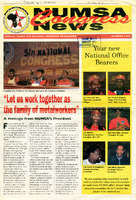 From the 25 to the 29 September, NUMSA held its Fifth National Congress. Seven hundred and sixty-two delegates came from all our locals. They had prepared well. We saw from the debate. I was afraid before the Congress. I was not happy. 80% j of the shop stewards you elected in 1996 were new. I thought the level of debate at the Congress was not going to be high. But I was wrong - the level of debate was high. We must be proud of ourselves. Thank you for mandating your representatives to Congress - that is what we mean by worker control and democracy. We are doing our work under different conditions compared to before April 27, 1994. We have a democratically elected government in place. It is not as hostile as its predecessor. But the reality of the situation is that as workers in the workplace, nothing has changed. Management is coming to us with new ideas like kaizen, team-work, etc. These are all about eliminating waste. They define waste as anything that is not absolutely essential to production. They want to get to the lowest levels of inputs, equipment, material and workers. This means more and more control over workers' time and activities, a faster workplace, longer and more irregular hours. They standardise jobs and make the workplace more regimented. So we have to focus our efforts collectively on our “core business†- to represent our members effectively. We have to fight for job security, training, technical skills and better increases. We have to do all these under difficult conditions, for example, reduction of tariffs to conform with the requirements of the World Trade Organisation. We do not want the country's economy to be cushioned forever but the drastic restructuring results in job loss and factory closures. We must have an alternative in place to ensure that people do not once more swell the swollen ranks of the unemployed. Work organisation is taking place in different forms in different workplaces. We are involved in these processes. I know that when shop stewards give report backs and persuade members to accept certain things in exchange for job security, members tend to regard them as management stooges. We mustn't think like that. It is causing division amongst us. Outside the workplace, the balance of forces is not in favour of the working class for reasons that we all know. We must work together as workers, shop stewards, administrators and organisers to build our Union into a coherent vehicle. Only a strong vehicle can play a leading role in freeing our people economically. Let us work together as the family of metalworkers!
 -
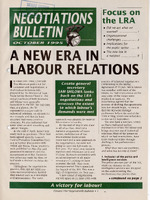 IN FEBRUARY 1995, Comrade Tito Mboweni published for comment and negotiations, a draft Labour Relations Bill, prepared by the Ministerial Task Team led by Halton Cheadle. The initial reactions of both business and labour were generally favourable to the Bill. We indicated that, at a glance, the Bill represented a major shift in industrial relations, an advance in our struggle and that its basic structure had many positive elements. We also indicated that some areas needed reworking and radical changes. By the end of April, labour was ready with its positions. These had been agreed upon by Cosatu's Central Executive Committee (CEC) and in further discussions with Fedsal and Nactu. These positions were published on May Day and presented to business and the government on 4 May. Business was either not ready by then, or had made a decision to delay the process. Throughout the negotiations process, they did not table any constructive proposals. Instead they labeled ours as unworkable and unreasonable. The same approach was adopted by most of the commercial media. By the end of May it was clear to all of us that, short of a massive programme of mass action, mobilisation of the international trade union movement and a new approach to the negotiations, we were not going to have the Bill ready by this year. The result was massive marches and stay aways on 6 and 19 June. Business responded with an advertisement in all major newspapers' claiming to have accepted the Bill. They even misrepresented Tito's speech at the launch of the Bill. This was a sign of desperation on their part. A new round of negotiations started again on 21 June 1995 with a series of trilateral negotiations culminating in the Nedlac Agreement of 19 July. While labour was satisfied with most of the issues, we had reservations on the way some of the issues were resolved or captured. We nonetheless agreed that the process of drafting the agreements into law should begin, to ensure that the bill went through parliament before the end of the 1995 sitting, which was scheduled to rise on 15 September. We now have a new law, which, as 1 have indicated earlier, represents a victory for labour and brings in a new era of industrial relations. Most of the issues on which we had reservations, have been resolved either through drafting or the parliamentary process.
 -
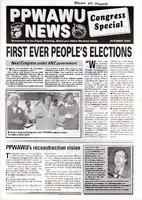 Congress understood well what Cde Nqakula was saying and how important it is to mobilise all our forces to come in with a huge ANC majority in the elections. Delegates made sure through a strong resolution on elections that PPWAWU will play its part: the union will send a fulltime PPWAWU person to COSATU for voter education. This person is Sipho Kubheka and he is already at COSATU head office. One shopsteward from each region will also be released to assist COSATU. Branches must run voter education workshops at once with the education co-ordinator's help. Shopstewards must get time off to train as voter educators, and all workers must give R1 towards voter education.
 -
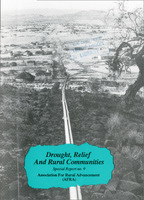 The Association for Rural Advancement (AFRA) has run a Drought Project since October 1992. The project's primary focus was to monitor drought conditions in the AFRA's operational area and to assist communities to access relief through providing them with relevant information and helping them to submit proposals to relief agencies. In attempting to do this, it became clear that the effects of drought on rural black communities was not a well understood phenomenon. We also found that relief strategies were informed more by economic, agricultural and meteorological criteria than social ones. This Special Report aims to contribute to the development of a more appropriate drought management strategy, especially with regard to rural communities. In attempting to make this contribution, the Report examines the factors involved in redefining drought and drought relief perspectives in relation to rural communities. However, the range of factors involved and the scarcity of useful information on them, dictate that this is merely an introduction. The complexities and implications arising from the introduction of these factors into drought management in South Africa should be explored on an on-going basis. Because of the scarcity of relevant information about the effects of drought on black rural communities in South Africa, this Report has relied on AFRA's limited monitoring of such communities. Some information was also gathered through Participatory Rural Appraisal (PRA) methods. There were also difficulties in getting information about relief schemes and their operations as most relief agencies were reluctant to release this information. As a result, almost all the relief related information in this Special Report was obtained from publications and reports of the National Consultative Forum on Drought.